
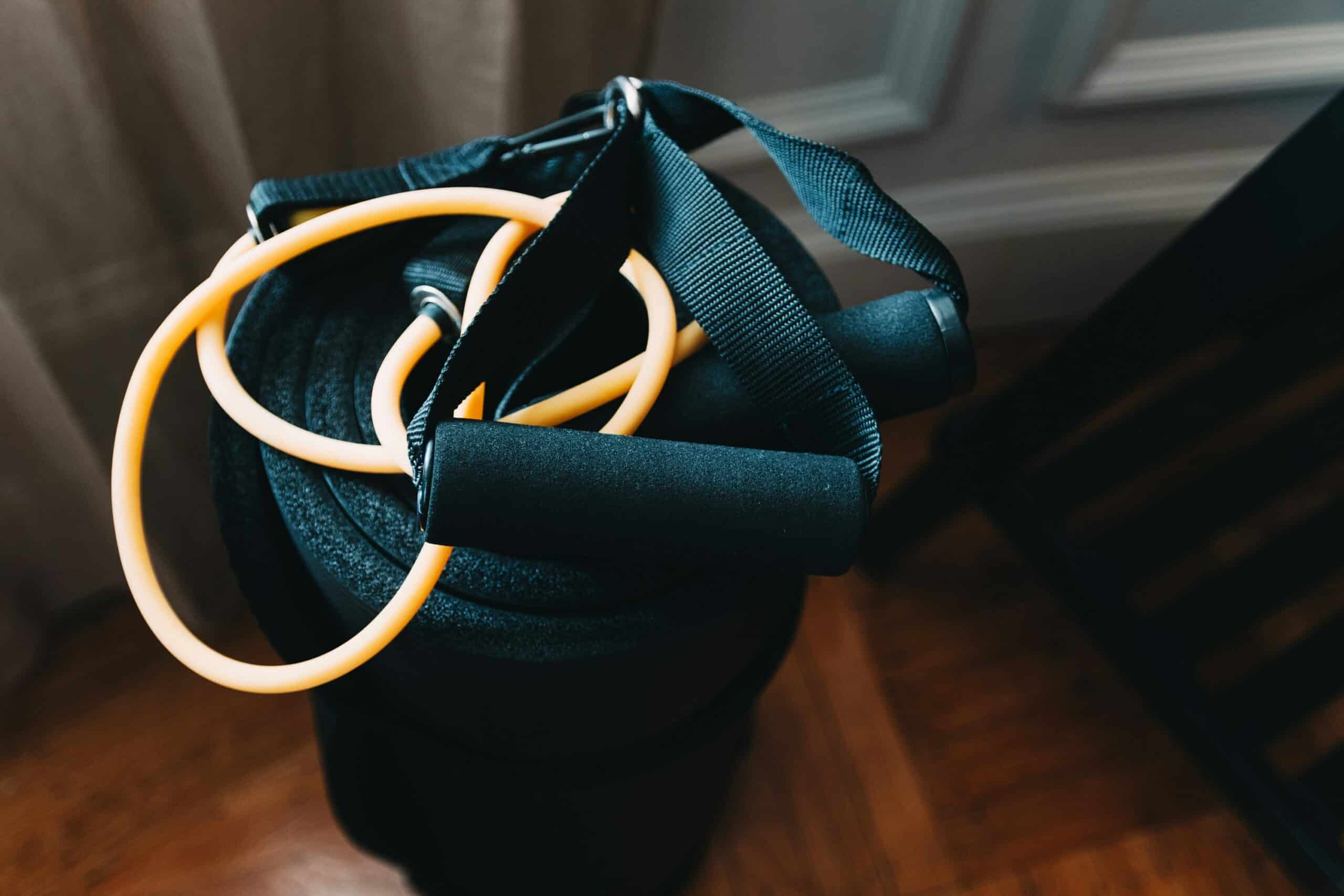
Resistance bands suit migraine-prone strength training because they load a muscle gradually and never require the breath holding that heavy barbell work does. The best resistance bands for migraine-safe strength training are the light and medium sets that let you train below the effort level where you would brace, since the International Classification of Headache Disorders recognizes a primary headache type provoked by exertion1. Straining against a load you can barely move is the part worth avoiding, not strength work itself.
Aerobic exercise has the larger research base here, mostly because it has been studied more rather than because strength work has been shown to be worse. That comparison is worked through in cardio against strength training.
Activity comes up in migraine management for a reason beyond general fitness. Diener and colleagues list obesity among the modifiable factors associated with the transition from episodic to chronic migraine, alongside medication overuse, mood and sleep-disordered breathing2. No single one of those explains the transition on its own.
Medical Disclaimer
This article is for educational purposes only and does not replace medical evaluation or treatment by a qualified clinician. Equipment does not treat or prevent migraine. Head pain that comes on with exertion needs medical assessment before you continue training.
Quick Verdict
A set of flat loop bands in graded light resistances is the right first purchase, because it keeps you well below bracing effort. Add a long tube set with handles for pulling work at chest height. Skip the heavy pull-up assist bands entirely, since those are the ones that invite straining.
Key Takeaways
- Band resistance builds through the range, so the hardest point is predictable.
- Breath holding against a heavy load is the mechanism most often avoided.
- Overhead pressing loads the neck directly, so horizontal work is the safer default.
- Light and medium resistances cover far more than people expect.
- Moderate intensity is what the exercise research used, not maximal effort.
- Hydration and a meal beforehand remove two common confounders.
How We Picked These Bands
We selected for equipment that makes moderate effort easy to stay inside, which rules out the heaviest assistance bands and the very short high-tension loops.
Then we weighted anything that lets you train at or below shoulder height, since overhead work is the pattern most often reported as aggravating.
We have not run comparisons or measured these, so nothing here is a result from our own testing, and no product here is claimed to prevent or treat migraine. Whether strength training suits you, and at what intensity, is a conversation for your clinician.
1. A Graded Flat Loop Band Set, Best Overall
Why It Stands Out
A set of fabric or latex loops in several light resistances lets you pick an effort level precisely, which is exactly what training below bracing threshold requires. Small increments matter more here than range.
Loops also suit lower body and hip work, which is high-volume training that never involves the neck at all.
Worth Knowing
Latex loops roll and pinch on bare skin, while fabric versions stay put and cost more. Most people end up preferring fabric for hip work.
Resistance labels are not standardized between brands, so a medium in one set is not a medium in another.
This suits lower body work and anyone starting out. Skip the heaviest loops in a set at first. Best for: precise light resistance that keeps effort well below straining.
Check Price on Amazon2. Tube Bands With Handles, Best for Pulling Work
Why It Stands Out
Handles let you row and pull at chest height, which trains the upper back without lifting anything over your head. Upper back work is also what tends to help a desk-rounded posture.
Tube sets usually stack, so you can combine two light tubes rather than jumping to one heavy one.
Worth Knowing
Tubes wear at the point where they meet the clip, and a tube that snaps under tension does so at speed. Inspect the attachment regularly.
Anchoring matters. A door anchor at waist height is far more useful than looping a tube around furniture.
This suits upper back and arm work at or below shoulder height. Skip pressing patterns overhead with these. Best for: rowing and pulling without raising the arms overhead.
Check Price on Amazon3. A Door Anchor, Best Accessory
Why It Stands Out
A fixed anchor point turns a tube band into a cable machine, which unlocks horizontal rows and presses at a consistent height. Consistency is what lets you judge effort week to week.
It costs very little and it removes the awkward improvising that pushes people into odd positions.
Worth Knowing
These need a door that closes away from you, and a door that opens toward you is a genuine hazard. Check the direction before loading it.
The foam block can mark a painted door edge over time.
This suits anyone using tube bands at home. Skip it if no suitable door exists. Best for: a consistent anchor height for rowing and pressing.
Check Price on Amazon4. Light Adjustable Dumbbells, Best Free Weight Option
Why It Stands Out
Some movements are simply better loaded by a weight than a band, and a light adjustable pair covers them without the jump in effort a heavy set invites. Small increments keep you in the moderate range.
Weights also give honest feedback about load, which bands do not because tension changes through the range.
Worth Knowing
Heavier is the temptation and the thing to resist. The risk in strength training here comes from maximal effort rather than from weights as such.
Adjustable mechanisms vary in how fast they change, and a slow one discourages the light sets you actually want.
This suits movements bands do poorly, like carries and light presses. Skip the heavy end of the range. Best for: honest load feedback at light weights.
Check Price on Amazon5. An Exercise Mat, Best Floor Surface
Why It Stands Out
Floor work makes up a large share of band training, and a mat keeps elbows, knees and the back of the head off a hard surface. It also stops a band anchored under a foot from sliding.
A dedicated exercise mat is thicker than a yoga mat, which suits lying work better.
Worth Knowing
Thick mats are unstable for standing work, so you step off for anything on your feet. New foam mats also off-gas for a while.
Length matters more than thickness if you are tall, since a short mat leaves your head on the floor.
This suits any floor-based routine. Skip it for purely standing work. Best for: keeping pressure off the head, elbows and knees on the floor.
Check Price on Amazon6. A Band Resistance Chart and Log, Best Progress Tool
Why It Stands Out
Band tension is hard to judge, so written records are the only way to tell whether you are creeping upward in effort over weeks. Creeping upward is the thing to catch early.
A log also lets you line sessions up against attack days, which is the same habit used for tracking triggers generally.
Worth Knowing
Trigger identification carries a high false-positive rate, so a few coincidences do not establish a pattern. Treat a log as a record rather than a verdict.
Paper works as well as anything and does not involve a screen.
This suits anyone trying to find their own intensity ceiling. Skip it if you already keep a detailed diary. Best for: noticing effort creep before it becomes a problem.
Check Price on AmazonResistance Training Equipment at a Glance
| Item | Main Use | Neck Load | Watch For |
|---|---|---|---|
| Flat loop band set | Lower body and hips | None | Labels vary by brand |
| Tube bands with handles | Rows and pulls | Low if kept below shoulders | Wear at the clip |
| Door anchor | Fixed anchor height | None | Door must close away from you |
| Light adjustable dumbbells | Carries and light presses | Low at light loads | Temptation to go heavy |
| Exercise mat | Floor work | None | Length if you are tall |
| Training log | Tracking effort creep | None | Coincidence is not a pattern |
What to Look For in Resistance Equipment
Small increments between resistances
A set that jumps from easy to very hard forces you into the effort range you were avoiding. Graded light resistances are the whole point of buying a set rather than one band.
Movements that stay below shoulder height
Overhead work loads the neck and the upper traps directly, which is the region already carrying tension for many people. Horizontal rows and presses cover most of the same muscles.
Anchoring you can set up the same way twice
If the setup changes every session you cannot compare effort between them. A fixed anchor is what makes a band routine repeatable.
Durability at the join
Bands fail where they attach to something, not in the middle. Stitched sleeves and metal clips last longer than a tube crimped straight onto a handle.
Bands or Free Weights
Bands make straining harder to do accidentally
Resistance rises as the band stretches, so the difficult point arrives gradually rather than at the moment you unrack a weight. That gives you time to notice effort and stop.
Weights tell you the truth about load
A dumbbell is the same weight throughout, which makes progress and intensity legible in a way band tension is not. The risk lies in heavy maximal lifting rather than in weights themselves, so light pairs sidestep most of it.
What Trips People Up
Buying the heavy set first
Heavy assistance bands are the ones that require bracing to move at all. They are the opposite of what a cautious return to strength work needs.
Holding the breath through the hard part
Breath holding against effort raises pressure in the veins draining the head, which is the specific mechanism worth avoiding. Exhaling on the effort is the habit to build from the first session.
Training dehydrated or on an empty stomach
Dehydration and missed meals are both commonly reported triggers, so training on either confuses what caused what. Preventing dehydration migraines and electrolyte drinks cover that groundwork.
Returning too fast after an attack
The day after is its own question and ramping straight back to a previous load is how people get caught. Exercising the day after a migraine goes through it.
Where Strength Work Sits Alongside Everything Else
Posture is the overlap
Upper back work and desk posture address the same tension from two directions. Whether posture causes migraines and posture correctors cover the passive side.
Recovery tools are not training
Rolling and percussion address soreness rather than building strength, and they suit the days between sessions. Foam rollers and massage guns sit there.
Mobility work has its own kit
Stretching is a separate job from loading a muscle, and straps make it easier to do without craning. Neck stretchers and stretching straps cover it.
Recommended Reading
Worth reading next: whether exercise can trigger migraines, which covers exertional head pain and how often it is reported.
When to See a Neurologist
- A sudden severe headache during or straight after exertion, especially a first occurrence.
- Head pain that follows lifting reliably rather than occasionally.
- Any headache you would describe as the worst of your life.
- New headaches starting after age fifty.
- Attack frequency climbing over weeks or months.
- Weakness, numbness, speech trouble or vision loss alongside pain.
- Headache with fever, neck stiffness or a rash.
- Pain that wakes you or peaks on waking.
- Any headache following a head or neck injury.
- Needing acute medication on most days.
- Neck pain or stiffness that does not settle between sessions.
- Attacks that stop responding to what used to work.
Resistance Band FAQ
What are the best resistance bands for migraine-safe strength training
A graded set of light flat loop bands covers lower body work, and tube bands with handles plus a door anchor cover rows and pulls at chest height. Light adjustable dumbbells fill the gaps bands handle poorly. The heavy assistance bands are the ones to leave out.
Is strength training safe with migraine
Strength work is less studied in migraine than aerobic exercise rather than shown to be worse, and the commonly discussed risk sits with maximal effort and breath holding rather than resistance training generally. Whether it suits you is a question for your clinician.
Why does breath holding matter
Holding the breath while straining raises pressure in the veins that drain the head, which is why exhaling through the effort is the standard advice. Keeping loads light enough that you never want to brace removes the problem at source.
Should I avoid overhead pressing
Overhead work loads the neck and upper traps directly, so many people doing this cautiously stay at or below shoulder height. Horizontal rows and presses reach most of the same muscles without that.
How intense should a session be
Moderate, because moderate intensity is what the exercise research generally used, and sudden intense exertion appears among the more commonly reported exercise triggers. If you are bracing or holding your breath, the load is above where you wanted to be.
Can resistance training reduce attack frequency
Nothing here should be bought as a preventive. Regular moderate aerobic exercise has the stronger evidence base in migraine, and preventive treatment decisions belong with a clinician rather than with equipment.
When should I see a doctor about this
See a doctor if a headache comes on suddenly during or just after lifting, if head pain follows training reliably, or if it comes with weakness, numbness, speech difficulty or vision changes. A first severe exertional headache warrants assessment before you train again.
How do I tell whether training is affecting my attacks
Keep a simple written record of sessions and attack days, and give it months rather than weeks. Trigger identification carries a high false-positive rate, so a handful of coincidences is not evidence of a pattern.
Sources
- Headache Classification Committee of the International Headache Society (IHS). The International Classification of Headache Disorders, 3rd edition. Cephalalgia. 2018;38(1):1-211.
- Diener HC, Solbach K, Holle D, Gaul C. Chronic migraine: classification, characteristics and treatment. Nat Rev Neurol. 2016;12(8):455-464.
