
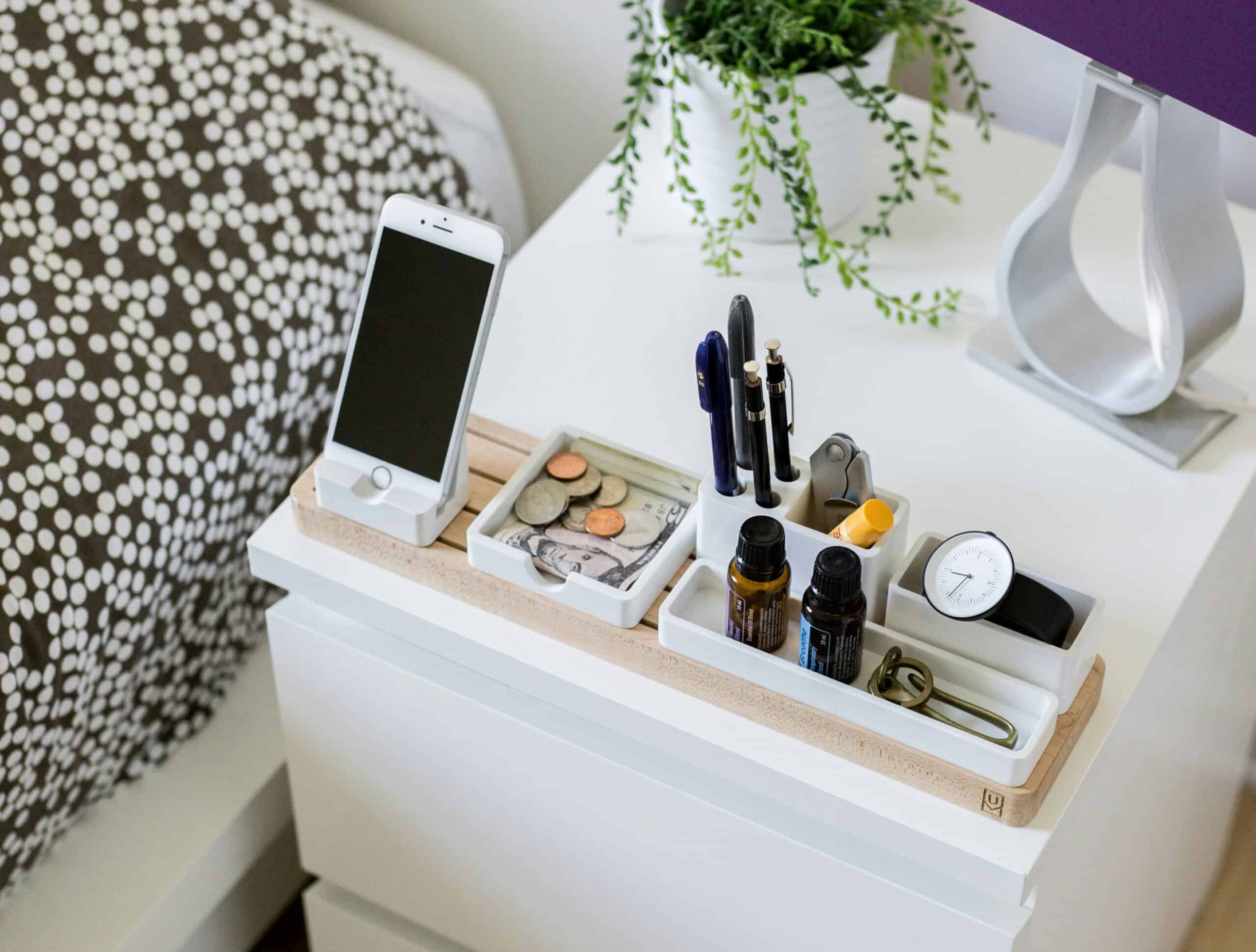
An attack that starts at three in the morning is a search problem. Light hurts, noise hurts, and the things you need are in four different rooms, so the useful setup is one that puts them within reach of the pillow before you need them.
Both of the senses you would normally use to find something are the ones under pressure. The International Classification of Headache Disorders lists photophobia and phonophobia among the symptoms used to define migraine1, which is why reaching rather than searching is the design goal here.
The best bedside caddies and nightstand organizers for migraine keep a fixed small set of items in fixed positions, so you can find them by feel. The desk and bag version of the same idea sits in supplies for a migraine emergency kit.
Medical Disclaimer
This article is for educational purposes only and does not replace medical evaluation or treatment by a qualified clinician. Organizing your bedside does not treat migraine. Attacks that wake you from sleep, or are worst on waking, are worth raising with a doctor.
Quick Verdict
A hanging bedside caddy is the best value, because it needs no furniture and puts things at hand height rather than on a surface you have to feel across. Pair it with a dim amber night light and keep the contents fixed. Position matters more than the product.
Key Takeaways
- Fixed positions matter more than capacity, because you will be finding things by feel.
- A hanging caddy works where there is no room for a nightstand.
- Keep the set small, since a crowded caddy is as bad as a drawer.
- Amber or red light at the lowest usable level beats a phone screen.
- Water within reach removes one reason to get up.
- Medication storage near a bed needs thinking about if children are in the house.
How We Picked
We sorted these by where they mount, since a bed against a wall and a bed with a nightstand allow different things.
Then we weighted whether items sit in distinct compartments, because that is what lets you find one by feel rather than by looking.
We have not compared these products directly, so nothing here is presented as a result from our own testing. Nothing in this category treats migraine, and medication storage choices are worth discussing with a pharmacist.
1. A Hanging Bedside Caddy, Best Overall
Why It Stands Out
A fabric caddy slung over the mattress edge puts pockets at hand height beside your shoulder, which is a shorter reach than any surface. It needs no furniture and no fixing.
Separate pockets also mean each item has one place, which is the whole point when you are not opening your eyes.
Worth Knowing
These slide on some mattresses and need the anchor flap properly under the mattress. A caddy that moves in the night defeats the fixed-position idea.
Soft pockets also swallow small items, so a hard case for anything tiny helps.
This suits most beds, especially without a nightstand. Skip it on a mattress with no gap to anchor into. Best for: pockets at hand height with no furniture needed.
Check Price on Amazon2. A Compartment Nightstand Tray, Best for a Surface
Why It Stands Out
A divided tray turns an open nightstand into defined slots, so your hand lands on the right thing. It also stops items migrating as you reach past them.
A raised lip keeps a water bottle from being knocked off, which is the common nightstand accident.
Worth Knowing
A tray still requires reaching across and above a surface, which is a longer movement than a hanging pocket. For someone avoiding head movement that difference is real.
Trays also encourage filling, and a full tray is no easier to navigate than a bare nightstand.
This suits anyone with a nightstand already. Skip it if you have no bedside surface. Best for: giving an existing surface fixed positions.
Check Price on Amazon3. A Clamp-On Bedside Shelf, Best Where There Is No Room
Why It Stands Out
A small shelf clamped to the bed frame or headboard creates a surface where no floor space exists, which suits small rooms and bunks. It is rigid, so nothing tips.
Being attached to the bed means it stays in the same place relative to you rather than relative to the room.
Worth Knowing
Clamps fit a limited range of frame thicknesses, and a divan base with no rail gives nothing to clamp to. Check the frame before ordering.
Hard shelves at head height are also something to catch yourself on while getting up.
This suits small rooms with a suitable frame. Skip it on a divan base. Best for: a rigid surface where a nightstand will not fit.
Check Price on Amazon4. A Dim Amber Night Light, Best Light Source
Why It Stands Out
Enough light to find a caddy and nothing more is the goal, and a dim amber source does that without the shock of a ceiling light or a phone screen. Picking something up becomes possible rather than painful.
Plug-in versions with a manual switch beat anything motion-activated at a bedside, since motion sensors fire when you turn over.
Worth Knowing
Even a dim light is light, and some people do better with none at all during an attack. It is worth knowing which you are before relying on it.
Options are covered in night lights for migraine.
This suits anyone who needs to find things at night. Skip motion-activated versions at a bedside. Best for: just enough light to locate what you need.
Check Price on Amazon5. A Lidded Bedside Water Bottle, Best for Staying Put
Why It Stands Out
A sealed bottle you can knock over without consequence is what makes keeping water at the bedside practical. It also removes a reason to stand up and walk to a kitchen.
A wide base and a one-handed lid both matter when you are not sitting up properly.
Worth Knowing
Insulated bottles keep water cold overnight, which not everyone wants first thing. Plain plastic or glass avoids that.
Hydration generally is its own topic, covered in water bottles for migraine hydration.
This suits every bedside setup. Skip open glasses entirely. Best for: water you can reach without consequences.
Check Price on Amazon6. A Hard Case for Small Items, Best for Finding by Feel
Why It Stands Out
Earplugs, an eye mask and a pill case are small and similar to the touch, and a hard case with compartments makes each findable without looking. Small items are the ones that get lost in soft pockets.
A case also keeps earplugs clean, which matters more than it sounds.
Worth Knowing
Medication kept at a bedside is accessible to anyone else in the house, including children, which needs thinking about. A pharmacist is the right person to ask about storage.
Organizers for medication specifically sit in pill organizers for migraine medication, with earplugs and eye masks covering what goes inside.
This suits anyone keeping small items bedside. Skip loose storage of medication. Best for: small things you can identify without looking.
Check Price on AmazonBedside Setups at a Glance
| Item | Needs Furniture | Reach | Best For |
|---|---|---|---|
| Hanging caddy | No | Shortest | Most beds |
| Compartment tray | Yes | Across a surface | Existing nightstands |
| Clamp-on shelf | Suitable frame | Short | Small rooms |
| Dim amber night light | Outlet | n/a | Finding anything at all |
| Lidded water bottle | No | Short | Every setup |
| Hard case | No | Inside the caddy | Earplugs, mask, pills |
What to Look For
Distinct compartments
One large pocket is a bag, and a bag has to be searched. Several small compartments let your hand go to a position rather than hunting.
Mounting that suits your bed
Hanging caddies need a mattress edge to anchor under and clamp shelves need a frame rail. Check what your bed actually offers before choosing a format.
Quiet materials
Stiff plastic and crinkly fabric are loud at three in the morning, and sound sensitivity is part of what you are managing. Soft-lined compartments are worth preferring.
Something that stays put
The entire value here is knowing where things are, so anything that slides or shifts overnight undermines it. Weight, anchoring and friction all matter.
Bedside Against a Grab Bag
Bedside is for the attack that wakes you
Fixed positions beside the pillow suit the situation where you cannot tolerate light and do not want to stand up. It lives in one place permanently.
A bag is for everywhere else
Work, travel and the car need a portable version with duplicates rather than items borrowed from the bedside. Moving things between the two is how something goes missing on a bad night.
Common Misconceptions
That more capacity is better
A caddy with twelve items in it has to be searched, which is the problem you were solving. Keep it to the few things you actually reach for.
That a phone is an adequate light
A screen is bright, blue-weighted and invites checking things. A dim dedicated light does the one job without the rest.
That organizing fixes night attacks
It makes them easier to manage and changes nothing about why they happen. Attacks that wake you are worth investigating, and why you wake up with migraines covers the possibilities.
That the bedroom setup is just the bedside
Light control, temperature and noise all matter at least as much as what is in reach. Bedroom setups for waking with migraine covers the room.
What Actually Goes In It
The short list
Water, an eye mask, earplugs, whatever acute medication you have been prescribed, and a dim light. Five things in five places is a system you can use with your eyes shut.
Replace what you use the next day
A caddy that is missing the thing you needed last time is worse than useless, because you reach for it confidently. Restocking is the maintenance.
Keep working in bed separate
A tray for a laptop on a recovery day is a different object from the caddy. Lap desks and bed trays cover that.
Sleep regularity does more than any product
Consistent sleep and wake times are among the better-supported lifestyle measures in migraine, and no caddy substitutes for that. How to sleep with migraine covers it.
Recommended Reading
Worth reading next: whether lack of sleep causes migraines, which covers why night attacks are worth investigating.
When to See a Neurologist
- Any headache you would describe as the worst of your life.
- A headache that comes on suddenly and peaks within moments.
- Pain that reliably wakes you from sleep.
- Headache that is consistently worst on waking.
- New headaches starting after age fifty.
- Attacks increasing in frequency over weeks or months.
- Weakness, numbness, speech difficulty or vision loss with an attack.
- Headache with fever, neck stiffness or a rash.
- Headache following any head or neck injury.
- Loud snoring or witnessed pauses in breathing alongside morning headaches.
- Needing acute medication on most days to function.
- Attacks that stop responding to what previously worked.
Bedside Caddy FAQ
What are the best bedside caddies and nightstand organizers for migraine
A hanging bedside caddy is the best value and needs no furniture, with a compartment tray for anyone who already has a nightstand. A clamp-on shelf suits small rooms, and a dim amber night light makes any of them usable.
What should I keep beside the bed
Water in a lidded bottle, an eye mask, earplugs, any prescribed acute medication, and a dim light. Keeping the list short is what makes it findable without looking.
Is a hanging caddy better than a tray
For most people yes, because the pockets sit at hand height beside your shoulder rather than across a surface. A tray is the better choice if you already have a nightstand and prefer a rigid base.
Should I keep medication at the bedside
Many people do, for the practical reason that an attack at night needs it quickly. Accessibility to children and others in the house is the thing to consider, and a pharmacist can advise on storage.
What kind of night light should I use
Dim and amber or red, with a manual switch rather than a motion sensor, since sensors trigger when you turn over. The goal is just enough light to locate something.
Will this help me sleep better
It makes a night attack easier to deal with rather than improving sleep itself. Consistent sleep and wake times are among the better-supported lifestyle measures, and that is a separate change.
Do I need a separate kit for travel
Yes, with duplicates rather than items borrowed from the bedside, because anything moved between the two eventually goes missing on a bad night. A packed bag kit stays packed.
When should I see a doctor about night-time attacks
See a doctor if headaches reliably wake you, are worst on waking, or come with loud snoring or witnessed breathing pauses, since sleep disorders and headache often travel together. A sudden severe headache at any time needs urgent assessment.
Sources
- Headache Classification Committee of the International Headache Society (IHS). The International Classification of Headache Disorders, 3rd edition. Cephalalgia. 2018;38(1):1-211.
