
If heat reliably tips you into an attack, the temperature of one room matters more than almost any gadget in the house. Portable air conditioners give you a way to hold that room steady when the weather refuses to cooperate. They are not medical devices, but they do let you push back on a trigger directly.
The American Migraine Foundation names weather changes as one of its ten migraine triggers, alongside stress, irregular sleep schedule, hormones, caffeine and alcohol, diet, dehydration, light, smell, and medication overuse. A separate guide on why weather shifts hit some people harder covers that background in detail. Heat is the piece of that trigger you can actually control indoors.
This guide covers six formats rather than six brand names. Cooling a room is comfort and trigger avoidance, not treatment. Nothing below will stop an attack that has already started.
Medical Disclaimer
This article is general information and not medical advice. Heat intolerance, and any new or worsening headache pattern, should be discussed with a doctor rather than managed with an appliance. Heat illness is a medical emergency, and this article is not about recognizing or treating it. If you feel confused, stop sweating, or become very unwell in the heat, seek emergency care immediately rather than adjusting a thermostat.
Quick Verdict
A single-hose self-evaporating portable AC suits most bedrooms, because it runs without tank emptying and installs in an afternoon. Choose dual-hose if the room heats fast and you want efficiency over simplicity. Skip evaporative coolers unless your climate is genuinely dry, since added humidity works against you.
Key Takeaways
- Portable air conditioners address a trigger, comfort and sleep quality, not the migraine itself.
- Self-evaporating single-hose units remove the chore that makes people abandon portable AC entirely.
- Dual-hose designs cool more efficiently but need two window openings and more setup patience.
- Noise matters more than raw cooling power if sound sensitivity is part of your attacks.
- Evaporative coolers add moisture, which suits dry climates and works against humid ones.
- Placement, a ceiling fan, and a clean filter change the result more than most spec sheets do.
How We Picked
Selection here starts with the trigger rather than with cooling power. A unit that cools brilliantly but rattles all night is a poor fit for anyone whose attacks come with sound sensitivity. Format, noise behavior, and maintenance load carried the most weight.
Section one draws on long-term ownership of one format. I cannot compare dual-hose units, window units, or circulators, because I have not run those. Sections two through six are buying-guide reasoning about formats, not accounts of hands-on use.
No capacity figures, prices, room dimensions, or sound levels appear below. Those numbers vary too much between models to state usefully at the category level. Check them on the specific unit you are considering instead.
Every recommendation assumes one room, usually a bedroom, and a person who wants fewer heat-driven bad days. If you need whole-home cooling, this is the wrong category.
1. A Single-Hose Self-Evaporating Portable AC, Best Overall
Why It Stands Out
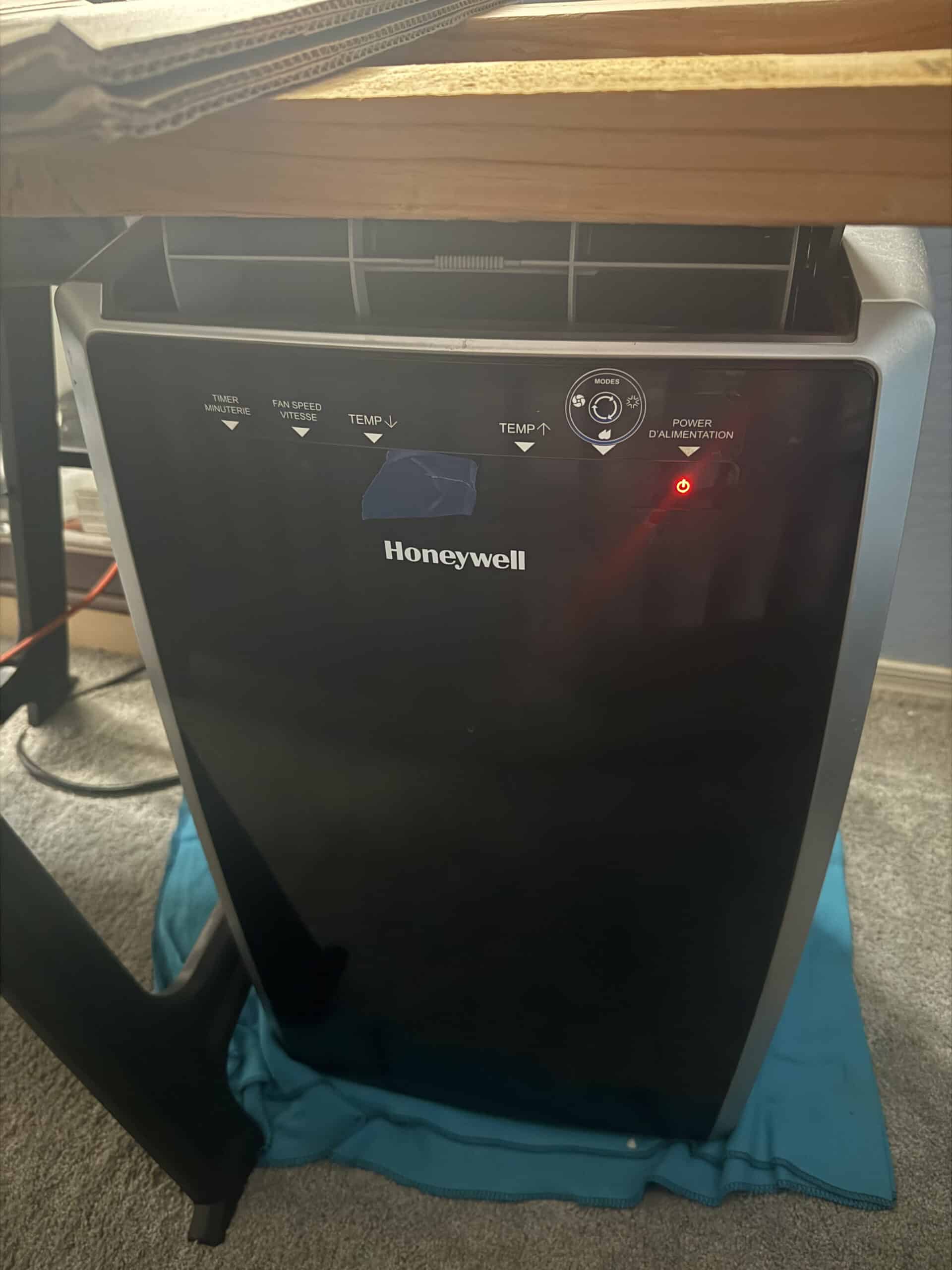
I have run the same portable air conditioner for five or more summers. It is a single-hose, self-evaporating unit, and I have never emptied a tank on it. It sits between the window and the bed.
I check the filter roughly every couple of months during the season, and that is the only maintenance it gets. I run it together with a ceiling fan. Those are one owner’s observations, not test results.
Worth Knowing
Single-hose units pull room air across the condenser and push it outside, which slightly lowers pressure indoors. Warm air then leaks in from hallways and gaps to replace it. In a closed bedroom this rarely matters, and in a large open space it does.
Self-evaporation also has limits. The self-evaporating side gets a little worse when humidity comes up during monsoon season. I can tell, though it still keeps up.
This format suits anyone who wants cooling with the least ongoing fuss, especially in a bedroom you can close off. Skip it if your space is open-plan or if you want maximum efficiency per hour of runtime. Pairing it with a small fan you can aim at your face covers the gap while the room comes down.
Check Price on Amazon2. A Dual-Hose Portable AC, Best for Fast Cool-Down
Why It Stands Out
Dual-hose designs draw outdoor air for the condenser and send it straight back out. The room air never gets used as cooling exhaust. That removes the negative pressure problem entirely, so warm air stops sneaking back in.
The practical result is a room that reaches a comfortable temperature sooner and holds it more steadily. For a heat-sensitive sleeper, steadiness is often worth more than peak output.
Worth Knowing
This section is buying-guide reasoning, not hands-on experience. Two hoses mean a bulkier window kit and a fussier seal. Both hoses also radiate heat, so poor insulation on them undercuts the efficiency advantage.
Setup takes longer, and the unit usually costs more than a single-hose equivalent of similar capacity.
Dual-hose suits people in hot climates, larger rooms, or homes where the door stays open. Skip it if your window is awkward, your space is tight, or simple installation is the priority. Anyone who already runs a separate unit for humidity control will notice the two appliances competing for outlets and floor space.
Check Price on Amazon3. A Quiet-Operation Portable AC, Best for Light Sleepers
Why It Stands Out
Sound sensitivity travels with migraine for a lot of people. A compressor that cycles loudly can wake you repeatedly, and broken sleep is itself on the American Migraine Foundation trigger list as an irregular sleep schedule. Quiet-focused models use inverter compressors and slower fan curves to soften that.
Look for a dedicated sleep or night mode. It usually drops fan speed and dims the display at the same time.
Worth Knowing
This section is buying-guide reasoning, not hands-on experience. Quiet models trade some cooling speed for lower fan noise, so the room comes down more gradually. Running one earlier in the evening solves most of that.
Manufacturer sound claims are usually measured at the lowest setting. Read owner reports about compressor start-up noise instead, since that is the sound that actually wakes people.
This format suits light sleepers, shift workers, and anyone whose attacks bring sound sensitivity. Skip it if you need aggressive cooling in a hot room and sleep through noise anyway. The same thinking applies across other appliances in a sensitive household.
Check Price on Amazon4. A Compact Small-Room Portable AC, Best for Tight Bedrooms
Why It Stands Out
Compact units exist for rooms where a full-size tower simply will not fit. They have a smaller footprint, lighter body, and shorter hose run. For a bedroom with limited floor space beside the window, that is the deciding factor.
Smaller also means easier to move between rooms during the day.
Worth Knowing
This section is buying-guide reasoning, not hands-on experience. Lower capacity is the trade, so a compact unit struggles in a sun-facing room or a poorly insulated one. Match the unit to the actual room, not to the smallest box available.
Compact models sometimes cut features first. Timers, remote controls, and sleep modes are the usual casualties.
This suits small bedrooms, studio spaces, and rentals where storage matters. Skip it if the room takes direct afternoon sun or has high ceilings. Getting the rest of the sleep setup right matters more when cooling capacity is modest.
Check Price on Amazon5. A Portable AC with a Programmable Timer, Best for Morning Attacks
Why It Stands Out
Plenty of people wake with an attack already underway. A programmable timer lets the room cool before you get into bed and again before you wake.
Better timers allow separate start and stop windows. Some pair with an app so you can adjust without getting up.
Worth Knowing
This section is buying-guide reasoning, not hands-on experience. Simple models offer only a countdown, which is far less useful than a true schedule. Check which one you are buying before assuming it can do both.
App-controlled units add a chirp or a bright status light in some cases. Look for a display that can be switched off completely.
Timers suit anyone with a consistent bedtime and morning attacks. Skip the feature if your schedule shifts constantly and you would just override it. Cooling towels are a useful backup here, and the ones that stay cold longest travel better than any appliance.
Check Price on Amazon6. An Evaporative Cooler for Dry Climates, Best Low-Cost Alternative
Why It Stands Out
Evaporative coolers pull air across a wet pad, which cools it as water evaporates. They need no window kit, no hose, and far less power than a compressor unit. In a genuinely dry climate that is a strong combination.
Setup amounts to filling a reservoir and plugging it in.
Worth Knowing
This section is buying-guide reasoning, not hands-on experience. The cooling comes from adding moisture to the air, so performance collapses as outdoor humidity rises. In a humid region the device makes the room feel worse, not better.
The American Migraine Foundation notes that high humidity and heat can easily lead to dehydration, which is another common trigger. That is a reason to be careful with anything that raises indoor moisture. Guidance on when added moisture actually helps is worth reading before you commit.
This suits dry inland climates, garages, and workshops. Skip it anywhere coastal, anywhere humid, and any bedroom where dampness is already an issue.
Check Price on AmazonPortable ACs at a Glance
| Format | Best for | Main trade-off | Setup effort |
|---|---|---|---|
| Single-hose self-evaporating | Closed bedrooms, low maintenance | Slight indoor pressure loss | Low |
| Dual-hose | Hot climates, larger rooms | Bulkier kit, higher cost | High |
| Quiet operation | Light and sound-sensitive sleepers | Slower cool-down | Low |
| Compact small-room | Tight bedrooms and studios | Lower capacity, fewer features | Low |
| Programmable timer | Waking with an attack | Countdown-only models mislead | Low |
| Evaporative cooler | Dry climates only | Adds humidity indoors | Very low |
What to Look For in a Portable AC
Does it drain itself, or will you be emptying a tank?
Self-evaporating units reuse condensate to cool the coil and vent most of it outside. Non-evaporating designs collect water you have to pour out. That chore is the single most common reason a portable AC ends up in a closet.
How quiet is it on the setting you will actually use?
Night mode figures are the ones that matter, not maximum-output figures. Compressor cycling is usually more disruptive than steady fan noise. Owner reviews describe that better than any spec sheet.
Will the window kit fit your window?
Sliding, casement, and awning windows all need different adapters. Many kits assume a standard double-hung opening. Measure before ordering, and budget for a foam seal if the fit is loose.
Can you control it without getting out of bed?
A remote or an app matters more than it sounds during an attack. Look for a display that dims or switches off completely. Bright panel lights are a real problem if light sensitivity is part of your pattern.
Single-Hose vs Dual-Hose
Single-hose is simpler and usually enough
One hose means one window opening and a faster install. Efficiency drops a little because indoor air becomes exhaust. In a closed bedroom of modest size, most people never notice the difference.
Dual-hose is more efficient and more demanding
Two hoses isolate the cooling loop from the room air entirely. That improves efficiency and stops warm air being drawn in from elsewhere. The cost is a larger kit, a trickier seal, and usually a higher price.
What Trips People Up
Leaving the hose long and coiled
A coiled exhaust hose radiates heat back into the room you just cooled. Keep the run as short and straight as the layout allows. Insulating sleeves help if the hose has to stretch.
Ignoring the window seal
A gappy window panel undoes a lot of the unit’s work. Foam strips and tape cost very little and fix most of it.
Forgetting the filter
A clogged filter cuts airflow and makes the unit work harder and louder. Rinsing it on a regular schedule during the season is enough for most homes. Set a reminder if you tend to forget.
Cooling without moving the air
Cold air pools near the floor and stratifies if nothing circulates it. A ceiling fan on low spreads it evenly and lets you run a milder setting. That combination is usually quieter than pushing the AC harder.
Related Reading
- tracking pressure swings at home
- keeping an eye on indoor air quality
- masking noise on bad nights
- cleaning the air in the same room
- shutting out light and afternoon heat
Frequently Asked Questions
Can portable air conditioners stop a heat-triggered migraine?
No. A portable AC changes the temperature of a room, which may help you avoid a trigger and sleep more comfortably. It does not prevent, treat, or shorten an attack, and it should never replace a treatment plan agreed with your doctor.
Is single-hose or dual-hose better for a bedroom?
Single-hose is usually enough for a closed bedroom, and it installs faster with a simpler window kit. Dual-hose makes more sense in a hot climate, a larger room, or a home where the bedroom door stays open. Efficiency favors dual-hose, while convenience favors single-hose.
Do portable air conditioners dry out the air too much?
Compressor-based units remove moisture as a side effect of cooling, which most people find comfortable. Some rooms do end up drier than you want, especially overnight. A humidifier can rebalance that, though running both at once wastes energy and is rarely necessary.
How loud is a portable air conditioner at night?
Loudness varies widely by model, and manufacturer claims usually reflect the lowest fan setting. Compressor cycling is what wakes people, not the steady fan hum. If sound sensitivity is part of your attacks, prioritize an inverter model with a genuine sleep mode.
Does an evaporative cooler work as well as a portable AC?
Only in dry climates. Evaporative coolers cool by adding moisture, so their performance falls as humidity rises. The American Migraine Foundation notes that high humidity and heat can easily lead to dehydration, another common trigger, so raising indoor moisture is not a neutral choice.
Where should a portable air conditioner sit in a bedroom?
Close to the window it vents through, with the shortest possible hose run. Avoid aiming cold air straight at your head all night, since that bothers a lot of people. Leave clearance around the intake so airflow is not blocked by furniture or bedding.
How much maintenance does a portable air conditioner need?
Filter cleaning is the main task, along with checking the window seal occasionally. Self-evaporating models remove the water-emptying chore in most conditions. Non-evaporating designs need the tank drained regularly, which is worth knowing before you buy one.
When should you see a doctor about heat-triggered migraine?
Talk to a doctor if attacks are becoming more frequent, more severe, or different in character, or if heat intolerance itself is new. Sudden severe headache, confusion, weakness, or fainting in the heat needs emergency care rather than a cooling appliance. An appliance is a comfort measure, not a substitute for assessment.
Sources
- American Migraine Foundation. Top 10 Migraine Triggers and How to Deal with Them. americanmigrainefoundation.org
