
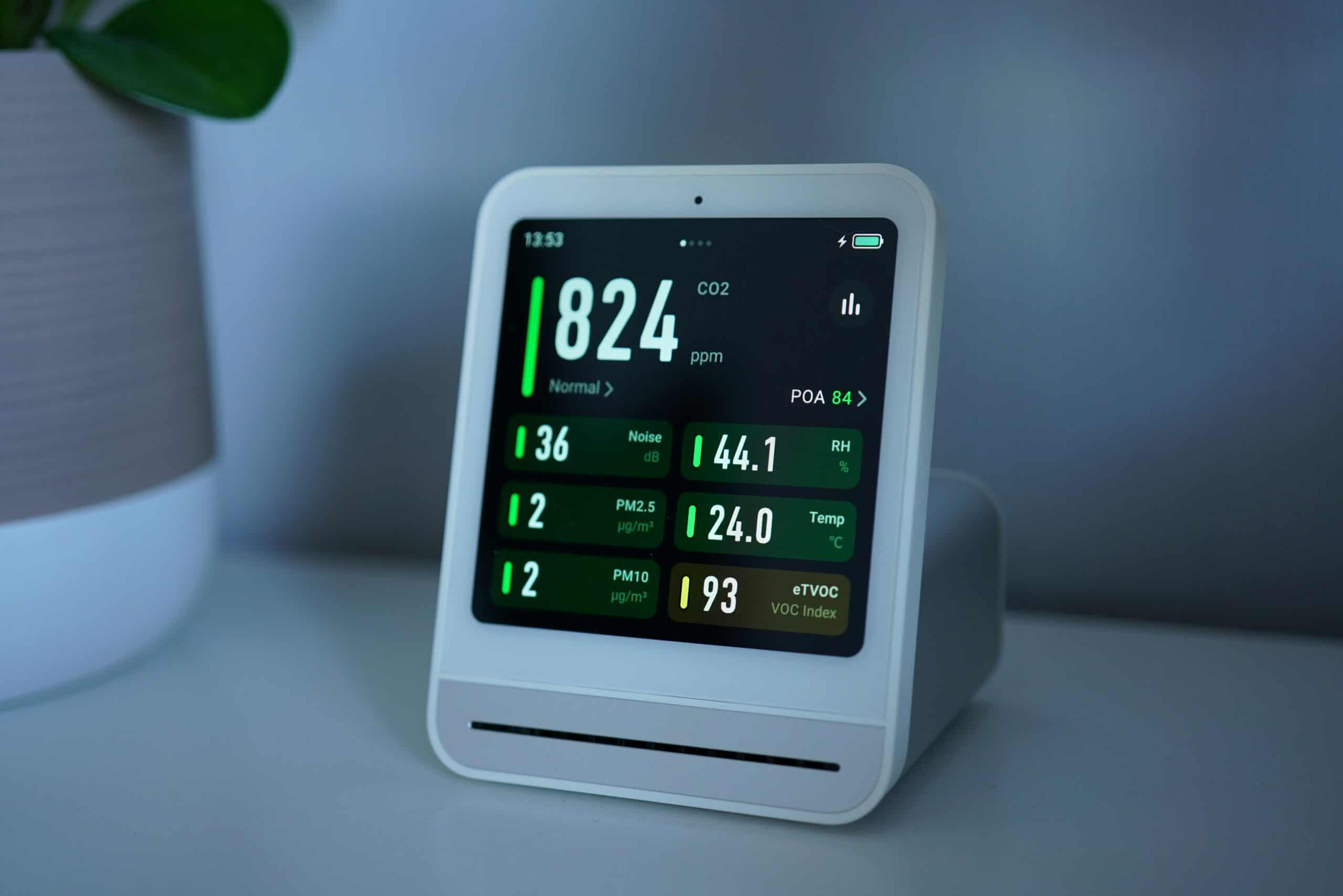
A monitor tells you what the air in a room is doing. It does not tell you whether that is why you have a migraine, and the gap between those two things is where most of the value and most of the confusion in this category live. Used carefully, a monitor turns a vague suspicion about a room into a number you can check. Used carelessly, it manufactures a trigger that was never there. Our note on common migraine triggers covers what the research actually supports.
Medical Disclaimer
This is general information about consumer devices, not medical advice. Air quality monitors are not medical instruments and do not diagnose or predict migraine. Migraine management belongs with a doctor or a headache specialist.
Monitor Types at a Glance
| Type | Measures | Logs over time | Best for |
|---|---|---|---|
| Multi-sensor monitor | Particulates, VOCs, CO2, humidity | Usually | General room picture |
| Particulate monitor | PM2.5 and PM10 | Varies | Dust and smoke |
| VOC monitor | Volatile organic compounds | Varies | Scent and chemical sensitivity |
| CO2 monitor | Carbon dioxide | Usually | Stuffy rooms and offices |
| Humidity and temperature | Relative humidity, temp | Usually | Basic environmental record |
| Portable monitor | Varies by model | Some | Comparing rooms and places |
The short version: a multi-sensor unit that logs over time gives you the most useful record, because a single reading tells you almost nothing and a pattern across weeks might tell you something worth mentioning at an appointment.
What the Evidence Supports
Research on migraine triggers identifies stress, sleep disruption, hormonal changes, weather changes, dehydration, and missed meals as commonly reported, with evidence mixed for many specific foods. Trigger identification from personal observation has high false-positive rates, which means people frequently name triggers that do not hold up. Our guide to smart thermostats for temperature triggered migraine takes that further.
Air quality specifically is less established than weather or sleep. Scent sensitivity during attacks is widely reported, and that is a different claim from indoor air quality causing attacks. Temperature shows up on many of these monitors, and a portable air conditioner is the usual answer when the reading runs high.
The honest position is that a monitor measures your environment accurately and tells you nothing about causation. That is still useful, because it replaces a guess about a room with a measurement. Readers watching pollen counts alongside indoor readings may want our overview of how allergies and migraine come up together.
1. A Multi-Sensor Monitor, Best Overall
Why It Stands Out
Measuring particulates, volatile compounds, carbon dioxide, and humidity together gives a picture of the room rather than one variable in isolation, which matters when you do not yet know what you are looking for.
Logging over weeks is what turns readings into a pattern worth examining.
Worth Knowing
Consumer sensors vary in accuracy, particularly for volatile compounds, where readings are often relative rather than absolute.
More sensors also means more numbers to over-interpret. Our roundup of air purifiers covers acting on what you measure.
This suits building a general picture. Skip it if you already know what you are tracking.
2. A Particulate Monitor, Best for Dust and Smoke
Why It Stands Out
Fine particulate readings respond to wildfire smoke, cooking, dust, and outdoor pollution drifting indoors, all of which are visible on the display within minutes.
The immediacy makes cause and effect easier to observe than with slower-moving measures.
Worth Knowing
Particulate sensors need clean airflow through them, and a unit tucked behind furniture reads its own microclimate.
Readings spike from ordinary cooking, which is normal rather than alarming. Our roundup of fragrance-free products covers the scent side.
This suits smoky or dusty environments. Skip it if scent rather than dust is your concern.
3. A VOC Monitor, Best for Scent Sensitivity
Why It Stands Out
Volatile organic compounds come from cleaning products, air fresheners, paint, and new furnishings, which are the things people with scent sensitivity most often report noticing.
A monitor shows when levels rise after cleaning or after a window has been shut all day.
Worth Knowing
Consumer VOC sensors generally report a relative index rather than identifying specific compounds, so a high reading tells you something changed and not what.
They also drift over time and need periodic recalibration in fresh air.
This suits scent-sensitive households. Skip it if you want specific compound identification.
4. A CO2 Monitor, Best for Stuffy Rooms
Why It Stands Out
Carbon dioxide is a reliable proxy for ventilation, and a rising number through a closed-door workday is a measurable version of a room feeling stale.
It is also one of the more accurate consumer measurements available, particularly on units using a proper infrared sensor.
Worth Knowing
Estimated CO2 derived from VOC sensors is not the same as a direct measurement, and the distinction is often buried in the specifications.
High CO2 indicates poor ventilation rather than a migraine trigger. Our guide to a migraine-friendly workspace covers the room itself.
This suits home offices and closed rooms. Skip it in well-ventilated spaces.
5. A Humidity and Temperature Logger, Best Simple Record
Why It Stands Out
Humidity and temperature are cheap to measure accurately and easy to act on, and both are commonly reported as noticeable by people with migraine.
A logging version records the overnight pattern you would otherwise sleep through.
Worth Knowing
These measure comfort variables rather than air quality in the pollution sense, which is a narrower scope than the category name suggests.
Weather-related migraine reports usually concern outdoor barometric changes rather than indoor humidity. Our roundup of barometric pressure monitors covers that.
This suits basic environmental tracking. Skip it if particulates are the concern.
6. A Portable Monitor, Best for Comparing Places
Why It Stands Out
A battery unit you can carry lets you compare an office, a car, and a bedroom rather than measuring one room and assuming the rest.
For someone who suspects a particular building, that comparison is the useful measurement.
Worth Knowing
Portable units generally carry fewer sensors and less accuracy than a mains-powered monitor.
Moving between environments also means readings need time to settle before they mean anything.
This suits comparing locations. Skip it for continuous logging in one room.
How to Use the Data Without Fooling Yourself
The failure mode in this category is straightforward. You buy a monitor because you suspect the air, you see a number rise on a day you get a migraine, and the suspicion hardens into a conclusion. Given how often reported triggers turn out to be false positives, that is a risk worth naming.
A more useful approach is to log without watching, and review after weeks rather than reacting daily. A pattern across dozens of days is worth mentioning at an appointment. A single correlation is not.
It also helps to remember that attacks have a prodrome phase, during which sensitivity to smell and light increases before the headache arrives. Noticing the air more on a day you later get a migraine may be a symptom rather than a cause.
None of that makes monitoring pointless. Poor ventilation and high particulate levels are worth fixing on their own terms, regardless of what they do or do not do to your head.
What to Look For
Does it log or only display?
A live number tells you about this moment. A logged record tells you about patterns, which is the only thing worth drawing conclusions from.
Which sensors are real?
Estimated CO2 derived from a VOC sensor is not a direct measurement. Check the specification rather than the marketing.
Where will it sit?
Sensors need airflow. A monitor behind a curtain or against a wall measures its own pocket of air rather than the room.
Can you export the data?
Records you can show a clinician are more useful than an app you scroll alone.
Monitor or Purifier?
Monitor first
Measuring tells you whether there is anything to fix, and in plenty of homes the answer is no. Buying a purifier without measuring is solving a problem you have not established.
Purifier when the numbers justify it
Persistently elevated particulates from smoke, dust, or outdoor pollution are a real reason to filter the air. Our roundup of quiet appliances covers that step.
Common Mistakes to Avoid
Treating a monitor as diagnostic
It measures air. It says nothing about your head, and no consumer device predicts an attack.
Reacting to single readings
Cooking spikes particulates. A closed room raises CO2. Both are normal and neither is a finding.
Confusing prodrome with trigger
Heightened sensitivity to smell before an attack is a recognized early symptom. Noticing the air more may be the migraine starting rather than causing it.
Skipping the appointment
Environmental data is a supplement to migraine management, not a substitute for it. Our note on questions to ask a neurologist covers where the data belongs.
Recommended Reading
See our roundup of dehumidifiers, our note on humidifiers, our guide to migraine prodrome symptoms, and a roundup of migraine tracking apps, and choosing a migraine supplement.
Air Quality and Migraine FAQ
Can poor air quality trigger migraines?
Some people report it, and it is less established in the research than triggers like sleep disruption, stress, and weather changes. A monitor can tell you what your air is doing and cannot establish that it is causing your attacks.
What should I measure first?
Particulates and carbon dioxide are the two most reliably measured by consumer devices, and both point at practical fixes: filtration and ventilation respectively. Volatile compound readings are relative rather than absolute.
Are consumer air quality monitors accurate?
Reasonably so for particulates and for CO2 when using a proper infrared sensor. Volatile compound sensors generally report an index rather than identifying specific compounds, and they drift over time.
How long should I log before concluding anything?
Weeks rather than days, and the appropriate conclusion is usually a pattern worth mentioning at an appointment rather than a trigger you have identified. Reported triggers have high false-positive rates.
Could noticing smells more mean a migraine is starting?
It can. Heightened sensitivity to smell and light is a recognized part of the prodrome phase that precedes the headache. That makes it easy to mistake an early symptom for a cause.
Do I need a purifier as well?
Only if measurements show something worth filtering. Persistently high particulates from smoke or outdoor pollution justify one. Buying a purifier before measuring solves a problem you have not established.
Where should I put the monitor?
Somewhere with free airflow, away from windows, vents, and the kitchen, at roughly the height you spend time at. A unit tucked behind furniture measures its own pocket of air.
Should I bring the data to my doctor?
If you have a few months of it and a pattern you have noticed, yes, alongside your attack records. A clinician will interpret it in context rather than treating it as a result in itself.
When should I see a doctor about my migraines?
If attacks are becoming more frequent or severe, if they are not responding to what you currently use, or if the pattern changes noticeably. A sudden severe headache unlike any you have had before needs urgent assessment rather than tracking. Environmental data is a supplement to medical management and never a replacement for it.
Sources
- Lipton RB, Munjal S, Buse DC, et al. Results From the American Migraine Prevalence and Prevention (AMPP) Study. Headache. 2016;56(10):1635-1648. https://headachejournal.onlinelibrary.wiley.com/
- National Institute of Neurological Disorders and Stroke. Migraine. National Institutes of Health. https://www.ninds.nih.gov/health-information/disorders/migraine
