
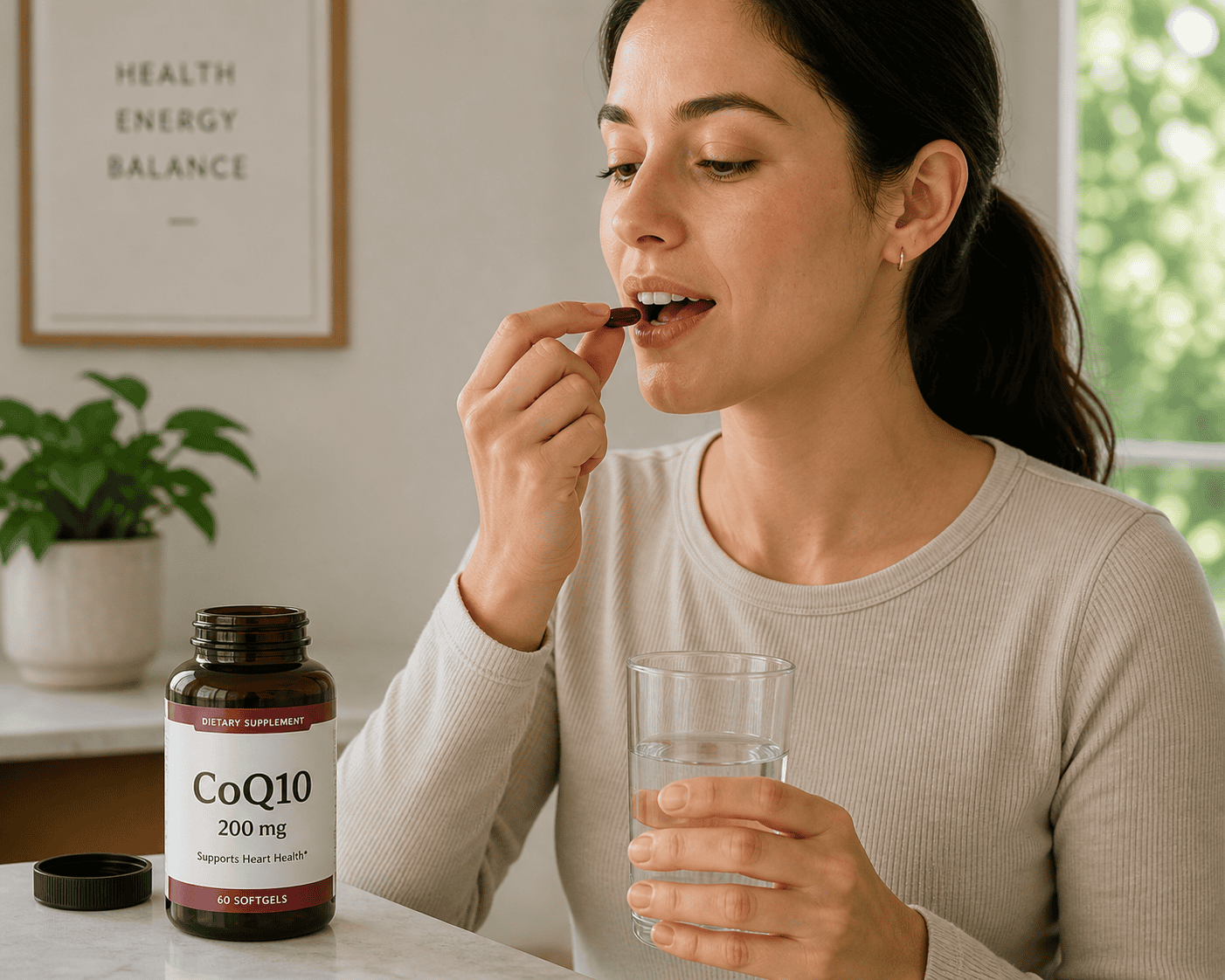
CoQ10 is one of the few supplements with serious research support for migraine prevention. Multiple controlled studies have shown meaningful reductions in migraine frequency, typically 25-50% fewer attacks per month, when patients take CoQ10 at therapeutic doses for 8-12 weeks. The American Headache Society includes CoQ10 in its list of supplements with Level B evidence for migraine prevention, alongside magnesium, riboflavin, and butterbur. For migraine sufferers exploring supplement-based prevention, CoQ10 is one of the few options with clinical evidence behind it rather than marketing claims. If you are weighing options, our guide on vitamin D supplements for prevention goes deeper.
The catch is that most consumer CoQ10 supplements underdose the active compound by 50-70% compared to the doses used in successful migraine studies. The research that produces results uses 100-300mg daily of bioavailable CoQ10. Many products on the shelf provide 30-60mg of the cheaper, less-absorbed form. Buyers take the supplement for months, see no migraine improvement, and conclude CoQ10 doesn’t work, when actually they were taking a fraction of the studied dose.
This guide covers the five best CoQ10 supplements for migraine prevention in 2026, evaluated on dose, bioavailability form, third-party testing, and the practical factors that determine whether the supplement delivers what the research suggests.
How CoQ10 Works for Migraine Prevention
CoQ10 (coenzyme Q10) is a compound the body produces naturally, concentrated in mitochondria where it plays a critical role in cellular energy production. The connection to migraines comes from research showing that migraine sufferers often have lower mitochondrial energy production efficiency than non-sufferers. Supplementing CoQ10 supports the mitochondrial function that’s running below optimal in migraine-prone individuals.
The mechanism isn’t theoretical. Studies measuring biomarkers of mitochondrial function in migraine patients show measurable improvement after CoQ10 supplementation, and the improvement correlates with reduced migraine frequency. The effect builds over 8-12 weeks rather than producing acute relief, CoQ10 is purely a prevention tool, not an acute treatment for active migraines.
For migraine sufferers, the practical implications are specific:
CoQ10 works best as part of a daily prevention routine rather than situational use. Skipping doses or starting and stopping based on migraine frequency defeats the mechanism, which depends on sustained mitochondrial support.
Results emerge gradually. Most patients see measurable improvement around weeks 6-8, with peak benefit around weeks 10-12. Anyone evaluating CoQ10 in less than two months is making the assessment too early.
CoQ10 combines well with other evidence-backed migraine supplements. Many headache specialists recommend a stack of magnesium glycinate, riboflavin (B2), and CoQ10 as a comprehensive supplement-based prevention approach.
What to Look For in CoQ10 Supplements for Migraines
Several criteria separate CoQ10 supplements that deliver migraine prevention benefits from products that don’t.
Dose: 100-300mg Daily
The research showing migraine prevention benefits used CoQ10 doses of 100-300mg daily, typically split into two doses. The most-cited study used 100mg three times daily (300mg total). Another commonly cited study used 150mg daily.
Products providing 30-60mg per serving cannot deliver these therapeutic doses without taking 4-5 capsules daily. While theoretically possible, the practical reality is that most users take the labeled dose and stop there, meaning a 60mg-per-capsule product produces 60mg/day intake, well below the studied effective range.
For migraine prevention specifically, look for products providing at least 100mg per serving with single-capsule dosing.
Form: Ubiquinol Beats Ubiquinone for Most Users
CoQ10 exists in two forms. Ubiquinone is the oxidized form, cheaper and more common in supplements. Ubiquinol is the reduced (active) form, more expensive but significantly more bioavailable, especially for adults over 30.
For migraine prevention, the form matters because migraine studies have used both forms successfully, but ubiquinol delivers measurable blood levels with smaller doses. A 100mg ubiquinol dose typically produces blood CoQ10 levels comparable to 200-300mg of ubiquinone.
Younger adults (under 30) absorb ubiquinone reasonably well and can use either form effectively. Adults over 40, or anyone whose previous CoQ10 supplementation didn’t produce results, should specifically choose ubiquinol formulations.
Bioavailability Enhancement
CoQ10 is fat-soluble and poorly absorbed when taken on an empty stomach. Quality supplements address this through softgel formulations that include healthy fats (typically rice bran oil or sunflower oil), which improve absorption significantly compared to powder-filled capsules.
Products labeled as “enhanced absorption” or “high bioavailability” with lipid carriers genuinely outperform standard powder capsules. The price difference is usually small and the absorption difference is meaningful.
Third-Party Testing
CoQ10 supplements vary significantly in actual content versus label claims. Third-party testing through USP, NSF, ConsumerLab, or similar organizations verifies that products contain the dose listed at the purity claimed.
For prevention supplements taken daily for months at a time, third-party verification matters more than for one-off consumer products. The cumulative impact of a product delivering 60% of the labeled dose for 12 months is meaningful.
Manufacturing Quality
Look for products manufactured in cGMP-certified facilities, NSF-registered manufacturers, or USP-verified production. The supplement industry has minimal regulation in the United States, and the quality difference between certified and uncertified manufacturing is real.
Best CoQ10 Supplements for Migraine Prevention in 2026: Our Top 5 Picks
1. Qunol Mega Ubiquinol CoQ10 100mg, Best Overall
Best Overall CoQ10 for Migraines | Price: ~$32 (60 softgels)
Check Price on AmazonBest for: Most migraine sufferers, adults over 30 wanting bioavailable ubiquinol form, buyers prioritizing established quality with reasonable pricing.
The Qunol Mega Ubiquinol 100mg hits the practical sweet spot for migraine prevention. The 100mg dose per softgel matches the lower end of researched effective doses, the ubiquinol form delivers significantly better absorption than ubiquinone alternatives, and the patented water-and-fat-soluble formulation produces measurable blood CoQ10 levels that justify the price.
For migraine prevention specifically, taking one softgel twice daily (200mg total) puts you in the middle of the studied effective range. Taking three daily doses reaches the 300mg dose used in some studies. The flexibility to titrate up if needed without changing products is genuinely useful, many users start at 100mg and increase to 200mg around week 6 if they haven’t seen meaningful migraine reduction.
The third-party testing through Qunol’s manufacturing verification provides reasonable confidence that the labeled dose matches actual content. Qunol is one of the more established CoQ10 brands in the US market with consistent product quality across years.
PROS:
- 100mg ubiquinol per softgel hits researched dose range
- Patented bioavailability enhancement formulation
- Established brand with consistent quality
- Allows flexible titration to higher doses
- Reasonable price for ubiquinol formulation
CONS:
- Higher price than ubiquinone alternatives
- Some users report mild stomach upset
- Patented formulation locked to a single supplier
- Daily cost adds up over months of prevention use
For a complete migraine prevention strategy, our guides on the best magnesium supplements for migraine prevention and the best butterbur supplements cover the other Level B evidence supplements that combine well with CoQ10.
2. Doctor’s Best High Absorption CoQ10 200mg, Best for Higher Doses
Best for Higher-Dose Prevention | Price: ~$25 (60 softgels)
Check Price on AmazonBest for: Migraine sufferers needing the higher end of researched doses, younger adults who absorb ubiquinone well, buyers wanting 200mg single-dose convenience.
The Doctor’s Best 200mg uses ubiquinone (the cheaper form) but in a high-absorption formulation with BioPerine (black pepper extract) that significantly improves bioavailability of CoQ10. For users under 40 who absorb ubiquinone reasonably well, this product delivers researched-dose CoQ10 at a lower cost than ubiquinol alternatives.
The 200mg per softgel matches the middle of the studied effective range with single-dose convenience. Taking one softgel daily provides 200mg, eliminating the multi-dose timing question that complicates 100mg products.
The trade-off is the form. Ubiquinone absorption decreases with age, and the BioPerine enhancement helps but doesn’t fully close the gap with ubiquinol for older users. For adults over 50, the Qunol Mega Ubiquinol typically produces better blood CoQ10 levels despite the lower per-capsule dose.
PROS:
- 200mg per softgel hits the middle of the researched range
- BioPerine enhancement improves ubiquinone absorption
- Lower cost than ubiquinol alternatives
- USP verified for purity and dose
- Single-dose daily convenience
CONS:
- Ubiquinone is less bioavailable for older adults
- BioPerine can interact with some medications
- Larger softgel size, some find it harder to swallow
- Less effective than ubiquinol for those with absorption issues
3. Nordic Naturals Ubiquinol CoQ10 100mg, Best Premium Pick
Best Premium CoQ10 | Price: ~$45 (60 softgels)
Check Price on AmazonBest for: Buyers prioritizing premium manufacturing standards, users with sensitive stomachs needing high-purity formulations, and those wanting the most refined ubiquinol product available.
Nordic Naturals is best known for fish oil, but makes a premium ubiquinol CoQ10 worth considering for migraine prevention. The 100mg per softgel matches the researched dose range, the ubiquinol form provides good absorption across age groups, and the manufacturing standards exceed most competitors.
The premium positioning is genuine. Nordic Naturals products undergo third-party testing for purity, freshness, and authenticity. The softgels contain no artificial colors, flavors, or preservatives. The fish gelatin shell is some users prefer over animal gelatin alternatives.
The trade-off is price. At $45 for 60 softgels, the per-day cost is significantly higher than the Qunol or Doctor’s Best alternatives. For sensitive users or those with specific quality preferences, the premium is justified. For most users on long-term prevention regimens, the Qunol delivers similar functional benefits at a lower sustained cost.
PROS:
- Premium manufacturing and purity standards
- Ubiquinol form for broad bioavailability
- Third-party tested for quality and freshness
- No artificial additives
- Established brand reputation in the supplement category
CONS:
- Highest price among ubiquinol options
- 100 mg dose may require 2x daily for higher prevention doses
- Daily cost compounds over months of use
- Premium features unnecessary for typical users
4. Nature Made CoQ10 200mg, Best Budget Pick
Best Budget CoQ10 | Price: ~$20 (80 softgels)
Check Price on AmazonBest for: Budget-conscious buyers, younger adults with normal absorption, first-time CoQ10 users testing whether the supplement helps before committing to premium options.
Nature Made delivers 200mg ubiquinone CoQ10 at the lowest reasonable price point for a USP-verified supplement. The dose matches researched effective ranges, the manufacturing standards meet basic quality benchmarks, and the per-day cost is genuinely accessible for sustained prevention use.
The trade-offs are predictable. The ubiquinone form means lower bioavailability than ubiquinol products. The basic softgel formulation lacks the absorption enhancements of premium alternatives. The flavor and aftertaste are stronger than refined formulations.
For users testing whether CoQ10 helps their migraines before committing to premium products, Nature Made provides genuine clinical-dose CoQ10 at a minimum financial commitment. Many migraine sufferers start with Nature Made for the first 3 months, evaluate whether they see migraine reduction, and either continue with Nature Made or upgrade to ubiquinol alternatives based on results.
PROS:
- Lowest price for clinical-dose CoQ10
- USP verified for purity and dose
- 200mg per softgel matches the researched range
- Wide retail availability
- Good first-time CoQ10 user option
CONS:
- Ubiquinone is less bioavailable than ubiquinol
- Basic formulation lacks absorption enhancement
- Strong CoQ10 aftertaste in some lots
- May produce weaker results than premium alternatives
5. Life Extension Super Ubiquinol CoQ10 100mg, Best for Combined Health Benefits
Best for Multi-Benefit Use | Price: ~$35 (60 softgels)
Check Price on AmazonBest for: Migraine sufferers also addressing cardiovascular health or general energy, users wanting CoQ10 with additional supportive nutrients, buyers preferring research-focused supplement brands.
Life Extension Super Ubiquinol combines 100mg ubiquinol with shilajit, a compound that some research suggests enhances CoQ10 cellular uptake. For migraine sufferers also concerned with cardiovascular health (CoQ10 has Level B evidence for some cardiovascular conditions) or general mitochondrial function, the additional ingredients provide some benefit beyond migraine prevention specifically.
Life Extension has a research-focused reputation in the supplement space. Their products undergo more clinical attention than typical consumer brands, and their formulations often reflect specific scientific rationale rather than general supplement industry trends.
The trade-off is that the additional ingredients increase the price relative to pure CoQ10 products. For users specifically targeting migraine prevention without other health concerns, the Qunol Mega Ubiquinol delivers comparable migraine-specific benefits at a lower cost.
PROS:
- 100mg ubiquinol matches the researched migraine dose
- Shilajit addition supports cellular uptake
- Research-focused brand reputation
- Useful for multi-benefit supplementation
- Premium third-party testing
CONS:
- Higher cost than pure CoQ10 alternatives
- Additional ingredients unnecessary for migraine-specific use
- Smaller manufacturer than mainstream brands
- Daily cost compounds for long-term prevention
How to Use CoQ10 Effectively for Migraine Prevention
Several practical considerations determine whether CoQ10 produces results.
Take CoQ10 with food containing fat. CoQ10 is fat-soluble, and absorption is dramatically improved when taken with meals containing healthy fats. Taking it on an empty stomach reduces effective absorption by 60-80%.
Be patient with results. CoQ10 builds tissue levels over weeks. The 8-12 week timeline reported in studies is real, not a marketing buffer. Anyone evaluating CoQ10 effectiveness in less than 2 months is checking too early.
Track migraine frequency objectively. Keep a migraine diary or use a tracking app to measure attacks before starting CoQ10 and during the trial period. Subjective impression of migraine frequency is unreliable; written records reveal actual changes that perception misses.
Combine with other evidence-backed supplements. CoQ10 works alongside magnesium glycinate, riboflavin, and, where appropriate butterbur for comprehensive prevention. Stacking multiple Level B evidence supplements often produces better results than any single supplement alone.
Continue medication management with your doctor. Supplements complement rather than replace prescription migraine prevention. If you’re on preventive medications like topiramate, propranolol, or CGRP medications, do not stop them based on supplement use without medical guidance.
Quick Comparison Table
| Supplement | Best For | Dose | Form | Price |
|---|---|---|---|---|
| Qunol Mega Ubiquinol | Most users | 100mg | Ubiquinol | ~$32 |
| Doctor’s Best High Absorption | Higher doses | 200mg | Ubiquinone + BioPerine | ~$25 |
| Nordic Naturals Ubiquinol | Premium pick | 100mg | Ubiquinol | ~$45 |
| Nature Made CoQ10 | Budget pick | 200mg | Ubiquinone | ~$20 |
| Life Extension Super Ubiquinol | Multi-benefit | 100mg | Ubiquinol + shilajit | ~$35 |
Our Verdict
Qunol Mega Ubiquinol CoQ10 100mg is the right starting point for most migraine sufferers. The bioavailable ubiquinol form delivers measurable blood CoQ10 levels at the 100-300mg daily range that migraine studies actually used, and the established quality justifies the price for sustained daily use. Take one softgel twice daily for two months, evaluate results against your migraine diary, and titrate up to three daily if you haven’t seen meaningful frequency reduction. Exercise sits alongside supplementation, and our note on cardio versus strength training covers which suits.
If single-capsule 200mg dosing matters more to you than ubiquinol absorption, Doctor’s Best High Absorption CoQ10 200mg delivers the higher researched dose with BioPerine enhancement at meaningfully lower cost. This works particularly well for users under 40 who absorb ubiquinone reasonably well anyway.
Premium-quality buyers and those with sensitive systems will find Nordic Naturals Ubiquinol CoQ10 worth the price difference. The third-party testing standards and clean formulation matter when you’re committing to daily use across months of prevention.
On a tight budget, Nature Made CoQ10 200mg delivers genuine clinical-dose CoQ10 with USP verification at the lowest price point that still meets quality standards. Many sufferers start here for a 3-month trial, then upgrade to ubiquinol if results warrant continued investment.
The one situation where additional ingredients beyond CoQ10 make sense is if you’re addressing cardiovascular health or general mitochondrial function alongside migraines. Life Extension Super Ubiquinol combines ubiquinol with shilajit for cellular uptake support, which justifies the price for multi-benefit use but isn’t necessary for migraine-specific prevention.
CoQ10 alone won’t eliminate migraines for most sufferers. Combined with magnesium glycinate at 400-600mg daily, riboflavin at 400mg daily, and butterbur where appropriate, the supplement-based prevention stack produces meaningful results for many sufferers within 2-3 months. Those who don’t respond adequately to supplement-based prevention should discuss prescription options including CGRP inhibitors, with their doctor.
Frequently Asked Questions
Does CoQ10 actually work for migraine prevention?
Yes, with caveats. Multiple controlled studies show CoQ10 reduces migraine frequency by 25-50% when taken at therapeutic doses for 8-12 weeks. The American Headache Society includes CoQ10 in supplements with Level B evidence for migraine prevention. Results vary by individual, and CoQ10 works as a prevention rather than an acute treatment.
What dose of CoQ10 should I take for migraines?
Research showing migraine prevention benefits used 100-300mg daily, typically split into two doses. The most-cited study used 100mg three times daily (300mg total). Start at 100-200mg daily for 6 weeks, evaluate results, and titrate up to 300mg if needed without seeing meaningful migraine reduction.
How long until CoQ10 helps migraines?
Most patients see measurable improvement at weeks 6-8, with peak benefit around weeks 10-12. Anyone evaluating CoQ10 effectiveness in less than 2 months is checking too early. The supplement builds mitochondrial CoQ10 levels gradually rather than producing acute relief.
Is ubiquinol or ubiquinone better for migraines?
Both forms have shown migraine prevention benefits in studies, but ubiquinol is more bioavailable, especially for adults over 40. Younger users absorb ubiquinone reasonably well. For users whose previous ubiquinone supplementation didn’t produce results, switching to ubiquinol often produces measurable improvement.
Can I take CoQ10 with my migraine medications?
CoQ10 generally combines safely with most migraine medications, including triptans, CGRP inhibitors, and traditional preventives like topiramate and propranolol. Always inform your doctor about supplement use to identify any interactions specific to your medication profile, but interactions between CoQ10 and migraine drugs are rare.
Are there side effects of CoQ10?
CoQ10 is well-tolerated by most users. Mild side effects can include stomach upset, headache (occasionally during initial weeks), and insomnia if taken late in the day. Take CoQ10 with breakfast or lunch rather than dinner to avoid sleep disruption. Discontinue if side effects persist beyond 2 weeks.
Can I take CoQ10 with magnesium and riboflavin for migraines?
Yes, and the combination often works better than any single supplement alone. CoQ10, magnesium glycinate (400-600mg daily), and riboflavin/B2 (400mg daily) all have Level B evidence for migraine prevention through different mechanisms. Stacking these supplements produces results in many patients who didn’t respond adequately to single-supplement approaches.
Should I keep taking CoQ10 if it works?
Yes, CoQ10’s migraine prevention benefits depend on sustained mitochondrial support. Stopping CoQ10 typically produces a gradual return of migraine frequency over 4-8 weeks as tissue levels deplete. For users seeing meaningful benefit, continued daily use indefinitely is appropriate.
This is general information, not medical advice. Supplements can interact with medications and are not a substitute for care from a doctor, so talk to a healthcare professional before starting one.
More Migraine Supplement Guides
Frequently Asked Questions
When should I see a doctor about my migraines?
See a doctor if your migraines are frequent, severe, or changing in pattern, if over-the-counter options are not helping, or if you have new or unusual symptoms such as weakness, vision loss, confusion, or the worst headache of your life. A doctor can confirm the diagnosis, rule out other causes, and discuss prescription options.
Recommended Reading
Sources
- Headache Classification Committee of the International Headache Society. The International Classification of Headache Disorders, 3rd edition. Cephalalgia. 2018;38(1):1-211. https://ichd-3.org/
- American Headache Society. Position Statement on Integrating New Migraine Treatments Into Clinical Practice. Headache. 2019;59(1):1-18. https://americanheadachesociety.org/
- Silberstein SD, Holland S, Freitag F, et al. Evidence-based guideline update: Pharmacologic treatment for episodic migraine prevention in adults. Neurology. 2012;78(17):1337-1345. https://www.aan.com/Guidelines/
