
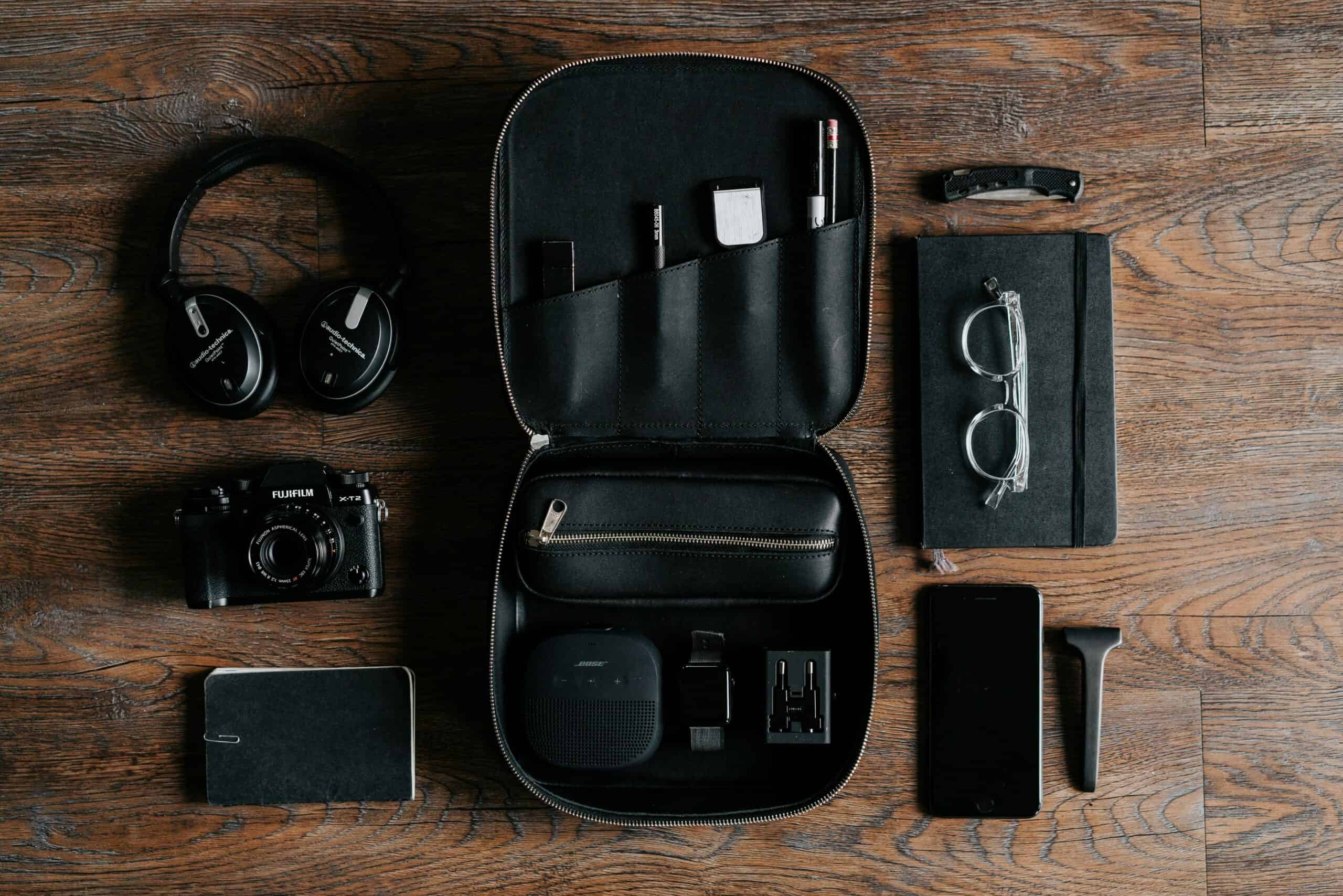
A migraine travel kit is a small bag that stays packed, holding the few things you reach for during an attack. The value is not the products themselves but having them together when symptoms start somewhere unfamiliar, which is when improvising works worst.
Travel also stacks triggers. Disrupted sleep, dehydration, skipped meals, cabin pressure changes, and unfamiliar light all appear in the same twenty-four hours, and several of those show up in trigger research as commonly reported.
Medical Disclaimer
This is general information rather than medical advice. Nothing here treats or prevents migraine. Carry your own prescribed medication in its original labeled packaging, keep it in hand luggage rather than checked baggage, and speak with a doctor before travel if attacks are frequent or severe.
The Short Version
Build around medication in original packaging, an eye mask, earplugs, and water. A small zip pouch that lives in your bag beats a larger kit you repack each trip. Everything else is optional and depends on which symptoms you actually get. Our motion sickness remedy guide covers what else belongs in that bag.
Key Points
- Medication travels in hand luggage, in original labeled packaging
- Light and sound blocking are the highest-value additions
- A kit that stays packed gets used, one you assemble does not
- Dehydration and skipped meals are common travel triggers
- Time zone changes disrupt sleep, which affects migraine both ways
- Nothing in a kit replaces a treatment plan from a doctor
How We Picked
We built around what people report reaching for during an attack rather than what makes a comprehensive-looking kit. Light blocking, sound blocking, hydration, and medication access cover most of it.
Size mattered. A kit that fits in a day bag travels every time, and a larger one stays at the hotel on the day you need it.
We favored items that need no power, since chargers and batteries add complications at airports and in unfamiliar rooms.
Products claiming to treat or prevent migraine were excluded. The American Migraine Foundation is clear that treatment plans come from clinicians, and a travel kit manages exposure and comfort rather than the condition.
Compact Zip Pouches
Why It Stands Out
The container is what makes a kit a kit. A dedicated pouch that stays packed removes the decision to bring things, which is the step that fails during a bad week.
Compact sizes fit in a day bag, which means the kit is with you rather than in a hotel room while you are out.
Worth Knowing
Clear or mesh panels help at security and when finding something with a headache. Opaque pouches mean rummaging.
Water resistance matters more than it sounds, since a leaking bottle in the same bag ruins medication packaging.
Best for anyone who currently assembles supplies per trip. Skip oversized organizer cases, which defeat the purpose.
Contoured Sleep Masks
Why It Stands Out
Photophobia is one of the diagnostic features of migraine in the ICHD-3 criteria, and hotel rooms, planes, and trains rarely offer full darkness. A contoured mask blocks light without pressing on the eyes.
The eye cups matter for anyone whose attacks involve pressure sensitivity, since a flat mask sits directly on the eyelids.
Worth Knowing
Strap pressure at the back of the head causes problems for some people during an attack. Wide flat straps distribute better than thin elastic.
Light leaks at the nose on most designs, which matters more on a plane than in a dark room.
Best for travel where you cannot control the lighting. Skip weighted versions if pressure worsens your symptoms, and options sit in migraine eye masks.
Reusable Silicone Earplugs
Why It Stands Out
Phonophobia appears alongside photophobia in the diagnostic criteria, and travel is loud. Aircraft cabins, stations, and hotel corridors all produce sound you cannot leave.
Silicone molds to the ear canal and blocks more than foam for many people, while being washable and reusable across a trip.
Worth Knowing
Fit is individual and a plug that works for one person is uncomfortable for another. Buying a variety pack first avoids committing to the wrong shape.
Full occlusion can make some people more aware of their own heartbeat and breathing, which is unpleasant during an attack.
Best for anyone whose attacks involve sound sensitivity. Skip if you need to hear announcements, and alternatives sit in earplugs for migraine.
Insulated Travel Water Bottles
Why It Stands Out
Dehydration appears in trigger research as commonly reported, and travel makes it likely. Aircraft cabin humidity is low, water is not always available, and routines that normally prompt drinking are absent.
An insulated bottle keeps water cold enough to want to drink, which matters more than capacity for most people.
Worth Knowing
Empty bottles pass airport security and full ones do not, so a bottle you fill after the checkpoint is the practical version.
Wide mouths are easier to fill from fountains and harder to drink from while moving.
Best for flights and long transfers. Skip heavy insulated steel if bag weight matters, and hydration generally is covered in preventing dehydration migraines.
Cooling Gel Eye Packs
Why It Stands Out
Cold applied to the head and eyes is among the most commonly used self-care measures during an attack. Travel-sized gel packs stay flexible when chilled and mold around the eye area.
Some designs work at room temperature as a light-blocking compress, which matters when no fridge or ice is available.
Worth Knowing
They need chilling to do the cold part, and hotel minibars and ice machines are inconsistent. A pack that helps only when cold is a pack that sometimes cannot help.
Cold suits some people and not others, and heat is preferred by many with tension-type involvement.
Best if cold already helps you at home. Skip if you find heat more useful, and options sit in cooling eye masks.
Pill Cases With Original Label Space
Why It Stands Out
Medication access is the core of any migraine kit, and organization matters when symptoms have already started. A case that separates acute from preventive medication reduces fumbling.
Compact cases fit in a pocket, which means medication travels with you rather than in a bag left elsewhere.
Worth Knowing
Prescription medication should travel in original labeled packaging. Many countries require it, and a loose pill case can create problems at borders regardless of what is in it.
Heat and humidity degrade many medications, so a bathroom bag is a poor location.
Best as a supplement to original packaging rather than a replacement. Skip decanting prescriptions entirely, and options sit in pill organizers for migraine medication.
Travel Kit Contents at a Glance
| Item | Addresses | Priority |
|---|---|---|
| Prescribed medication | The attack itself | Essential |
| Eye mask | Light sensitivity | High |
| Earplugs | Sound sensitivity | High |
| Water bottle | Dehydration | High |
| Cooling pack | Comfort during attack | Individual |
| Snack | Skipped meals | Individual |
| Zip pouch | Keeping it together | Structural |
What to Look For in a Travel Kit
Does it stay packed
The kit that works is the one you never disassemble. Duplicating a few cheap items so they live permanently in the bag beats moving things back and forth.
Does it fit your symptoms
Someone whose attacks center on light needs different contents from someone with nausea as the dominant symptom. Generic kits include things you will never use.
Does it survive the journey
Heat in a car, pressure changes on a plane, and being crushed in a bag all affect contents. Sturdy containers matter for anything fragile.
Is medication handled correctly
Original packaging, hand luggage, and a copy of the prescription cover most travel situations. That part is not optional.
Time Zones and Sleep
Sleep disruption cuts both ways with migraine. The American Academy of Sleep Medicine and American Headache Society describe the relationship as bidirectional, with sleep problems raising migraine risk and migraine disturbing sleep.
Crossing time zones disrupts sleep timing more than sleep duration, and that shift is what tends to matter. Arriving and immediately adopting local mealtimes and bedtimes shortens the adjustment for most people.
Short trips are sometimes better handled by staying on home time entirely, since a two-day trip does not leave enough time to adjust either way.
Sleeping on a plane rarely produces good sleep, and it does maintain some continuity. That is where the eye mask and earplugs earn their place rather than as attack management.
Flying Against Driving
Flying
Cabin pressure changes, low humidity, disrupted sleep, and limited water access stack up. Hand luggage rules also constrain what you can carry, which makes the small-kit approach necessary rather than preferred.
Driving
More control over light, temperature, and stops, and more exposure to glare and sustained posture. Supplies can be larger and stored in the vehicle, covered in car accessories for migraine sufferers.
Common Misconceptions
That a bigger kit is better
Kits that do not fit in a day bag stay behind. Four items you carry beat twelve you leave at the hotel.
That decanting pills is fine
Many countries require prescription medication in original labeled packaging, and border rules vary considerably. A pill case supplements packaging rather than replacing it.
That travel triggers are unavoidable
Several are manageable. Sleep timing, meal regularity, and hydration are all partly within your control even on a difficult itinerary, and the wider approach sits in traveling with chronic migraine.
That the kit is a treatment plan
It manages exposure and comfort. Treatment comes from a clinician, and a kit is no substitute for one.
Recommended Reading
- planning a trip
- traveling by car
- masks compared
- organizing medication
- staying hydrated
- knowing your triggers
- creating a migraine friendly workspace
Related: plan a vacation around migraines.
Frequently Asked Questions
What should be in a migraine travel kit?
Prescribed medication in original packaging, an eye mask, earplugs, and water cover the core. Beyond that it depends on your own symptoms, since cooling packs and snacks help some people and not others.
Can I take migraine medication on a plane?
Generally yes in hand luggage, and rules vary by country. Original labeled packaging and a copy of the prescription avoid most problems, and checking the destination’s rules before traveling is worth the few minutes.
Why does travel seem to trigger migraine?
Travel stacks several commonly reported triggers into a short period: disrupted sleep, dehydration, skipped meals, and unfamiliar light and sound. Whether any of those affect you depends on your own pattern.
Should medication go in checked baggage?
No. Checked bags are delayed or lost, and hold temperatures can be extreme. Anything you might need during the journey belongs in hand luggage.
Do cooling packs work without a fridge?
Some designs provide light blocking and mild pressure at room temperature, and the cooling effect needs chilling. Access to ice varies while traveling, which limits how reliable they are.
How big should the kit be?
Small enough to carry in a day bag every time. A kit left in a hotel room is not available during the afternoon when symptoms start.
When should I see a doctor?
If attacks are frequent, severe, or poorly controlled, or if you are traveling somewhere with limited medical access. Sudden severe headache unlike any before, or headache with weakness or speech difficulty, needs emergency care wherever you are.
Sources
- Headache Classification Committee of the International Headache Society. The International Classification of Headache Disorders, 3rd edition. Cephalalgia. 2018;38(1):1-211.
- Lipton RB, Munjal S, Buse DC, et al. Predicting Inadequate Response to Acute Migraine Medication: Results From the American Migraine Prevalence and Prevention (AMPP) Study. Headache. 2016;56(10):1635-1648.
- American Migraine Foundation. Travel and Migraine. https://americanmigrainefoundation.org/
