
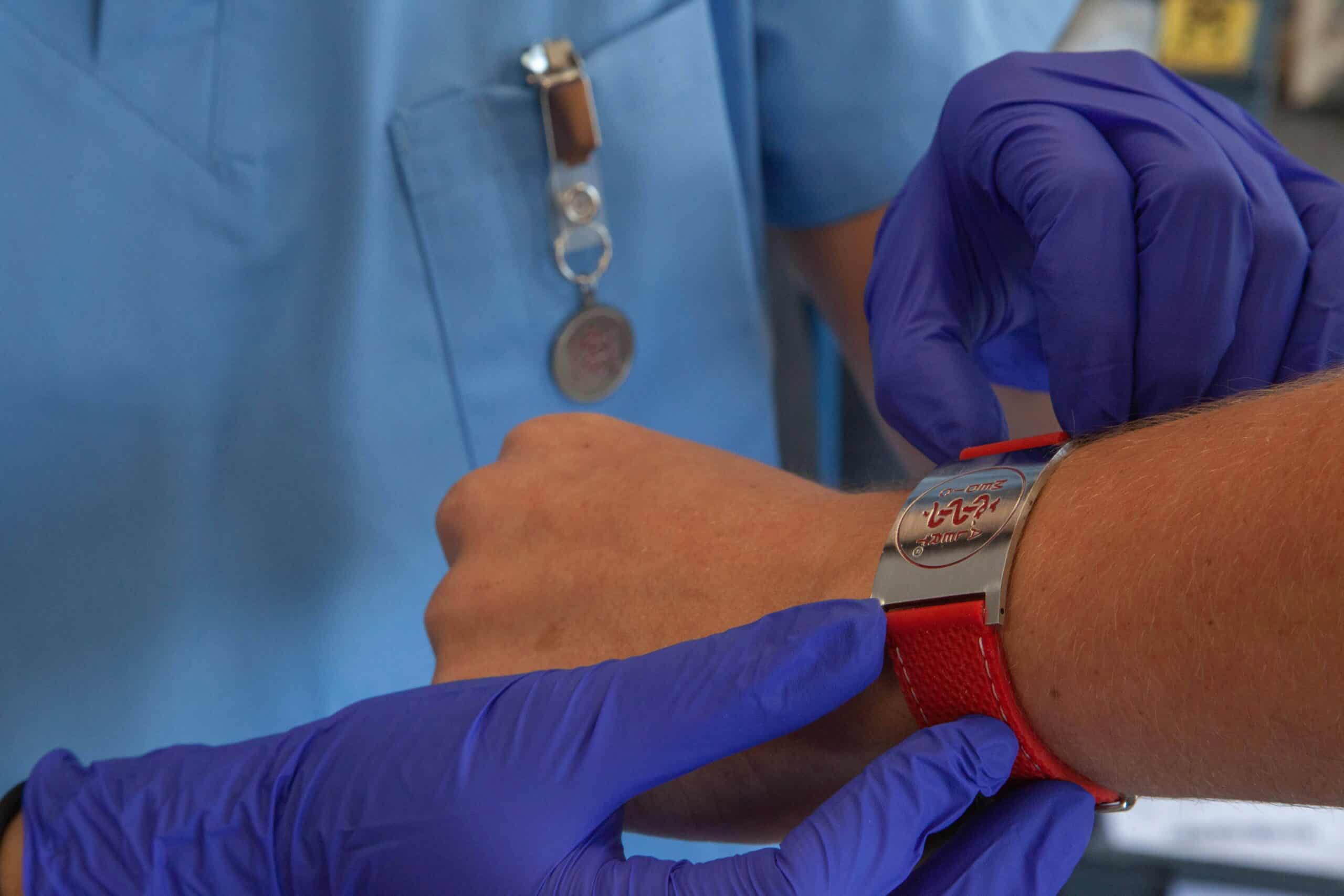
Most migraines do not need a medical ID. The subtypes that do are the ones where symptoms resemble something else in an emergency, and hemiplegic migraine is the clearest example, since one-sided weakness alongside speech difficulty presents almost identically to a stroke.
An ID does not stop anyone assessing you for stroke, and it should not. What it does is give responders a documented history in the seconds when you may be unable to speak, and that context sits alongside their assessment rather than replacing it.
Medical Disclaimer
This article is general information rather than medical advice. Sudden weakness, speech difficulty, vision loss, or the worst headache of your life require emergency assessment, and a medical ID does not change that. Decisions about what to engrave should be made with your neurologist or doctor.
Quick Verdict
A silicone or stainless band engraved with your diagnosis, key medications, allergies, and an emergency contact covers what responders need. Choose something you will wear daily, since an ID in a drawer helps nobody. Hemiplegic and vestibular migraine, aura with stroke risk factors, and complex medication regimens are the situations where one earns its place.
How We Picked
Legibility came first. An engraving too small or too decorative to read quickly defeats the purpose, and emergency responders are scanning rather than studying.
Daily wearability ranked next. The single most important feature is that you keep it on, so comfort and appearance matter more than they would on a purely functional item.
Information capacity mattered because migraine IDs often need to carry more than a diagnosis. Medication names, allergies, and a contact number take space.
We favored the recognized medical symbol, since responders are trained to look for it and an unmarked engraved bracelet may not get read at all. Readers who live by themselves may also want our guide to coping without help nearby.
Stainless Steel Medical ID Bracelet
Why It Stands Out
Durable, deeply engravable, and looks like ordinary jewelry, which matters for something worn every day for years. Deep engraving stays legible far longer than surface marking.
Stainless also resists corrosion from sweat and washing, which is what wears out cheaper metals within a year of constant wear.
Worth Knowing
Engraving space is limited by the plate size, and fitting a diagnosis, two medications, and a phone number requires a larger plate than most people expect.
Resizing a link bracelet needs tools or a jeweller, so getting the fit right at purchase matters.
Best for daily long-term wear and anyone who wants something that does not look medical. Skip if you need to update the information frequently.
Silicone Medical ID Band
Why It Stands Out
Comfortable enough to forget you are wearing it, which is exactly the property that keeps it on. Silicone survives showers, exercise, and sleep without corroding or catching.
Cost is low enough to own several, which means one can stay on while another is being replaced or updated.
Worth Knowing
Silicone looks obviously medical, and some people find that uncomfortable to wear daily. That visibility is a benefit in an emergency and a cost the rest of the time.
Printed or embossed text wears with abrasion, and a band two years old may be harder to read than it looks in normal light.
Best for active wearers, sleep, and anyone who finds metal uncomfortable. Skip if you want something that reads as jewelry.
Medical ID with QR Code
Why It Stands Out
Links to an online profile holding far more than an engraving fits. Full medication lists, neurologist contact details, attack history, and specific instructions all become available from a scan.
Updating is also immediate. A medication change means editing a profile rather than buying new hardware, which suits anyone whose treatment changes regularly.
Worth Knowing
A QR code depends on a working phone, network access, and a responder who scans it. Critical information should still be engraved directly rather than living only online.
Most also carry an ongoing subscription, and a lapsed subscription means a code pointing at nothing.
Best for complex medication regimens and anyone with several conditions. Skip as your only approach, since the physical engraving is what works without technology.
Medical ID Necklace
Why It Stands Out
Suits anyone who cannot wear wrist items for work reasons, and responders check the neck as well as the wrists. A necklace also stays out of the way during hand-intensive activity.
Larger pendants offer more engraving space than a wrist plate, which helps when there is a lot to fit.
Worth Knowing
Necklaces are more likely to be removed at night or during exercise, and an ID taken off regularly gets forgotten.
They can also sit under clothing where they are less immediately visible, which slightly reduces the chance of being noticed quickly.
Best for people whose work prohibits bracelets. Skip if you tend to take jewelry off, since wrist items stay on more reliably.
Medical ID Card for Wallet
Why It Stands Out
Holds a full page of information with no engraving limit. Diagnosis details, complete medication lists with dosages, allergies, and multiple contacts all fit comfortably.
It also costs very little and works alongside a bracelet rather than instead of one, covering the detail an engraving cannot.
Worth Knowing
Wallets get separated from people. A card only works if someone finds it, and in an emergency the wrist is checked before the pockets.
Paper cards degrade in a wallet, and an out-of-date card is worse than none if it lists medication you no longer take.
Best as a supplement to a worn ID, holding the detail. Skip as your only measure, since it may never be found.
Silicone Sleeve for Smartwatch
Why It Stands Out
Adds medical ID marking to something you already wear, which removes the adoption problem entirely. If a watch is on your wrist daily, an ID sleeve inherits that habit.
Smartwatches often hold emergency medical information in software too, which combines with the physical marking usefully.
Worth Knowing
Watches come off to charge, and that gap is predictable rather than random. Overnight is when some people most need the ID present.
Engraving space on a sleeve is small, usually enough for a diagnosis and little else.
Best for existing smartwatch wearers who will not adopt separate jewelry. Skip if your watch spends significant time off your wrist.
Medical ID Options at a Glance
| Type | Information capacity | Worn consistently | Updatable |
|---|---|---|---|
| Stainless bracelet | Limited engraving | High | No |
| Silicone band | Limited engraving | Very high | No |
| QR code ID | Unlimited online | High | Immediately |
| Necklace | Moderate engraving | Moderate | No |
| Wallet card | Extensive | Not worn | Reprint |
| Smartwatch sleeve | Minimal | High while worn | No |
When a Medical ID Is Worth It
Hemiplegic migraine is the strongest case. ICHD-3 defines it as migraine with aura including motor weakness, and that presentation overlaps with stroke closely enough that documented history genuinely helps the people assessing you.
Migraine with aura carries a modestly increased relative risk of ischaemic stroke compared with no migraine, though absolute risk in younger people without other factors remains low. Where other risk factors exist, particularly combined hormonal contraception, having your history available matters more.
Vestibular migraine and severe aura are also worth documenting, since disorientation and visual disturbance can leave you unable to explain your own history. Chronic migraine with a complex regimen makes the case on medication grounds, given that chronic migraine means headache on fifteen or more days a month for three or more months.
What to Engrave
The diagnosis, specifically
Hemiplegic migraine rather than migraine, since the subtype is the useful information. Plain migraine tells a responder very little they need.
Medications that matter in an emergency
Anticoagulants, beta-blockers, and anything affecting emergency treatment come first. Rescue medication for migraine matters less than drugs affecting what responders can safely give you.
Allergies
Drug allergies are among the most valuable things on any medical ID, and they take little space.
One emergency contact
A single number with a relationship label. More than one number wastes engraving space and slows down whoever is reading it.
Engraved Against Digital
The case for engraving
Works with no phone, no signal, no subscription, and no scanning. Responders are trained to look for the medical symbol and read what is there, and that path has no failure points.
The case for digital
Holds vastly more information and updates instantly when treatment changes. Best used alongside an engraving rather than instead of one, so that critical items are readable without technology. Keeping a written record helps too, and migraine journals serve that alongside.
Common Mistakes to Avoid
Engraving too much
A crowded plate slows reading. Four short lines that can be scanned in seconds beat eight that need studying.
Leaving out the medical symbol
The recognized symbol is what makes a responder look at the bracelet at all. Decorative engraved jewelry without it may be missed entirely.
Not updating after a treatment change
An ID listing a medication you stopped is misleading rather than merely outdated. Review it whenever your treatment changes, and CGRP medications covers a class that has changed many regimens recently.
Assuming an ID replaces emergency assessment
It does not, and it should not. Sudden weakness or speech difficulty needs emergency evaluation regardless of what your bracelet says, since a first stroke can happen to anyone with a migraine history.
Recommended Reading
- the subtype that most needs documenting
- dizziness and disorientation
- what aura involves
- what else to have ready
- where chronic begins
- getting specialist input
Frequently Asked Questions
Do I need a medical ID for migraine?
Most people with migraine do not. The strongest case is hemiplegic migraine, where one-sided weakness resembles stroke, along with vestibular migraine, severe aura, and complex medication regimens where documented history helps responders.
What should a migraine medical ID say?
The specific diagnosis rather than just migraine, medications affecting emergency treatment, drug allergies, and one emergency contact. Four short readable lines work better than a crowded plate.
Will a bracelet stop doctors treating me for stroke?
No, and it should not. Sudden weakness or speech difficulty gets assessed as a possible stroke regardless of your history, since anyone with migraine can also have a stroke. The ID adds context alongside that assessment.
Are QR code IDs better than engraved ones?
They hold far more and depend on a phone, signal, and an active subscription. Critical information belongs engraved directly, with a QR code adding depth rather than replacing the engraving.
Does migraine with aura increase stroke risk?
Migraine with aura is associated with a modestly increased relative risk of ischaemic stroke, though absolute risk in younger people without other risk factors remains low. Combined hormonal contraception raises it considerably, which is worth discussing with your doctor.
Bracelet or necklace?
A bracelet is checked first by responders and tends to stay on more consistently. A necklace suits people whose work prohibits wrist jewelry, with slightly lower visibility under clothing.
When should I see a doctor?
Talk to your doctor about what belongs on an ID, and seek emergency care for sudden weakness, speech difficulty, vision loss, or the worst headache of your life. Those need assessment now rather than after checking a bracelet.
Sources
- Headache Classification Committee of the International Headache Society (IHS). The International Classification of Headache Disorders, 3rd edition. Cephalalgia. 2018;38(1):1-211. https://ichd-3.org/
- Kurth T, Diener HC. Migraine and stroke: perspectives for stroke physicians. Stroke. 2012;43(12):3421-3426. https://www.ahajournals.org/journal/str
- Diener HC, Solbach K, Holle D, Gaul C. Chronic migraine, classification, characteristics and treatment. Nat Rev Neurol. 2016;12(8):455-464.
For the wider picture, see our guide to how to choose migraine glasses.
