
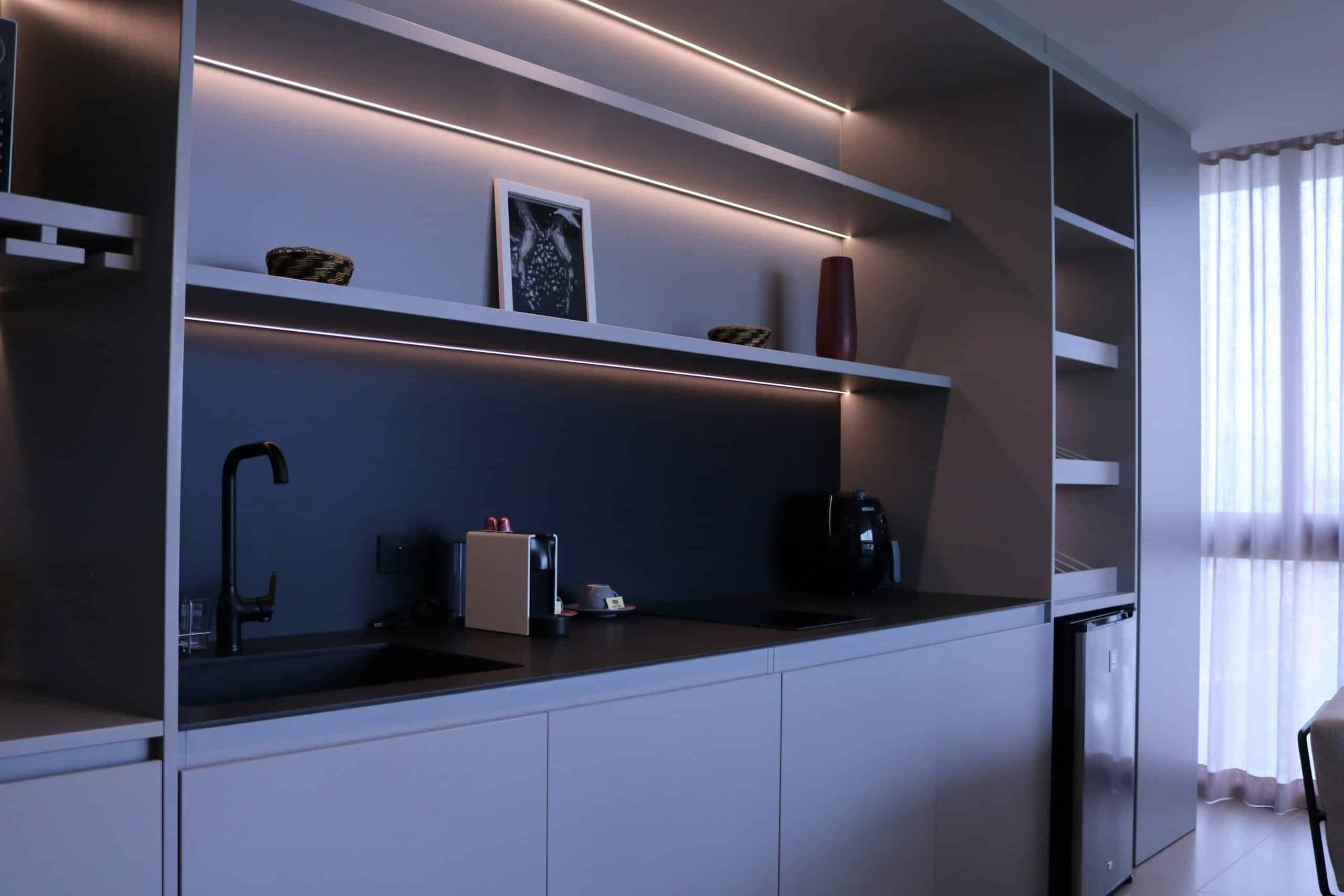
Kitchens combine every lighting problem in one room. Bright overhead fixtures, glossy countertops and appliances reflecting them, and task lighting aimed at your work surface at eye level. For anyone with light sensitivity, that adds up faster than a living room does.
The fixable parts are flicker, glare, and the ability to turn brightness down. All three respond to equipment changes rather than renovation.
Medical Disclaimer
This article covers lighting equipment rather than medical advice. It does not diagnose or treat anything. Talk to your doctor about light sensitivity, since photophobia has several possible causes. Seek immediate medical care for a sudden severe headache unlike your usual pattern, or one with fever, confusion, weakness, vision loss, or a stiff neck.
Key Points
- Flicker is invisible to most people and affects some regardless
- Reflective kitchen surfaces multiply the glare from one fixture
- Dimming needs compatible bulbs and switches together
- Under-cabinet lighting reduces reliance on overheads
- Color temperature affects comfort more than brightness alone
- Persistent light sensitivity between attacks warrants assessment
How We Picked
Flicker performance came first. Low-quality LED drivers produce rapid flicker that most people never notice, and the American Migraine Foundation lists flickering light among commonly reported triggers.
Glare control ranked next, since kitchens contain more reflective surfaces than any other room in a house.
Dimming capability mattered because a kitchen serves cooking, eating, and passing through, and those need different levels.
Renter compatibility counted. Plug-in and adhesive options cover people who cannot rewire anything.
Flicker-Free LED Bulbs
Why It Stands Out
Cheap LED bulbs pulse rapidly because of how their drivers regulate current. Most people never consciously see it, and some report headaches and eye strain in rooms lit by them.
Bulbs specified as flicker-free use drivers that hold output steady. Manufacturers who care about this state it, and those who do not stay silent.
Swapping bulbs costs less than any other change here and requires no tools.
Worth Knowing
Flicker often appears or worsens when a bulb is dimmed, so testing at the level you actually use matters more than testing at full brightness.
A phone camera pointed at a bulb sometimes reveals banding that your eye does not, which is a rough check rather than a measurement.
Worth changing first if overhead lighting bothers you. Skip unbranded bulbs with no flicker specification, and options sit in flicker-free bulbs.
Under-Cabinet Task Lighting
Why It Stands Out
Under-cabinet strips light the counter directly, which means you can leave the overhead off during most kitchen tasks.
Light coming from below eye level and pointing down does not enter your eyes directly, unlike a ceiling fixture.
Adhesive and plug-in versions install without wiring, which suits rentals and avoids an electrician.
Worth Knowing
Strips reflecting off a glossy countertop create glare from below, which some people find worse than the overhead they replaced.
A diffuser cover softens the output considerably compared with bare LEDs.
Worth adding in any kitchen where the overhead is the problem. Skip bare strips over reflective counters, and workspace lighting sits in migraine-friendly office lighting.
Dimmer Switches and Smart Plugs
Why It Stands Out
Control is what makes a kitchen workable across different states. Cooking needs light, and standing in the kitchen with an attack starting needs almost none.
Smart plugs and smart bulbs give dimming without touching wiring, which matters for renters and anyone avoiding electrical work.
Scheduled dimming in the evening also supports the consistent routine that sleep guidance emphasizes.
Worth Knowing
Dimmer and bulb have to be compatible. A mismatched pair produces buzzing and flicker, which is worse than no dimming at all.
Hardwired dimmer installation is electrical work. In many places that means an electrician, and it is not a task to improvise.
Worth adding for control over your own environment. Skip mixing incompatible dimmers and bulbs, and options sit in dimmer switches.
Warm Color Temperature Bulbs
Why It Stands Out
Cool white and daylight bulbs sit at higher color temperatures with more blue content, and many people with light sensitivity report those as harsher than warm equivalents.
Around 2700K to 3000K reads as warm and covers kitchen tasks perfectly well, despite the common assumption that kitchens need daylight bulbs.
Tunable bulbs let you run cooler light while cooking and warmer light in the evening from the same fixture.
Worth Knowing
Color temperature and brightness are separate specifications. A warm bulb at high output is still bright.
Color rendering matters for cooking, since a low CRI bulb makes it harder to judge whether food is done.
Worth switching if your kitchen runs cool white. Skip daylight bulbs in a room you use in the evening.
Diffusers and Shades for Bare Fixtures
Why It Stands Out
An exposed bulb creates a bright point source that reflects sharply off every glossy surface. A diffuser spreads the same light over a larger area, which reduces the intensity of each reflection.
Frosted covers and fabric shades both work, and either is cheaper than replacing a fixture.
This addresses glare specifically, which is a different problem from brightness and often the one that actually bothers people.
Worth Knowing
Diffusers reduce total output, so a room may need a higher-output bulb behind one.
Enclosed fixtures trap heat, and not every LED bulb is rated for enclosed use. Check before fitting one.
Worth adding to any bare-bulb fixture. Skip non-rated bulbs in enclosed shades, and glare reduction sits in anti-glare filters.
Motion-Sensor Night Lights
Why It Stands Out
Walking into a kitchen at night and switching on an overhead is a sudden bright light straight into dark-adapted eyes. A low motion-sensor light removes that entirely.
Amber and red output affects your eyes less than white, which matters if you are up during an attack or at night generally.
Under-cabinet and toe-kick placement keeps the source below eye level.
Worth Knowing
Sensor placement decides whether it triggers reliably or randomly. One catching movement from an adjoining room activates constantly.
Battery versions need recharging on a schedule people forget, and plug-in models avoid that.
Worth adding if you use the kitchen at night. Skip white output for night use, and light management generally sits in green light therapy lamps.
Kitchen Lighting at a Glance
| Problem | Fix | Needs an electrician |
|---|---|---|
| Flicker from cheap LEDs | Flicker-free bulbs | No |
| Harsh overhead | Under-cabinet task lighting | Not for plug-in |
| No brightness control | Smart bulbs or plugs | Not for smart options |
| Light feels cold | 2700K to 3000K bulbs | No |
| Sharp reflections | Diffusers and shades | No |
| Night brightness shock | Amber motion light | No |
What to Look For
Check flicker at your usual dimming level
Bulbs that are steady at full output often flicker when dimmed. Testing at the setting you actually use tells you more than a specification sheet.
Consider the surfaces, not just the fixture
Glossy counters, stainless appliances, and tile all reflect. Reducing the source intensity does more than moving a fixture in a reflective room.
Layer instead of brightening
Under-cabinet lighting plus a dimmed overhead beats one bright ceiling fixture for both comfort and function.
Match dimmer to bulb
Incompatible pairs buzz and flicker. Checking compatibility before buying avoids creating the problem you were solving.
Working Through the Room in Order
Changing everything at once tells you nothing about what helped. Doing it in sequence costs less and produces an answer.
Start with bulbs. Swapping the overheads for flicker-free warm bulbs takes ten minutes and addresses the two most common complaints at once.
Live with that for a couple of weeks before doing anything else. If the room feels better, the problem was flicker or color temperature and you are finished.
If it still bothers you, add control next. A smart bulb or plug lets you find the brightness that works rather than choosing between full output and darkness.
Task lighting comes third, and it is the change that lets you stop using the overhead at all. That is the biggest improvement for most people and also the most effort.
Diffusers and night lights are refinements once the main sources are handled. Neither is worth doing before the bulbs.
Noting how the room feels at each stage turns this into information you can give a doctor rather than a series of purchases.
Overhead Against Task Lighting
Overhead fixtures
Light the whole room and sit above eye level, so they enter your field of view and reflect off every surface. Useful and worth dimming.
Task lighting
Lights the work surface from below eye level and pointing down. It handles most kitchen activity without the overhead on at all.
Common Misconceptions
That LED means flicker-free
Many LEDs flicker at rates most people cannot see. The driver quality determines this, and price alone does not indicate it.
That kitchens need daylight bulbs
Warm bulbs at 2700K to 3000K light a kitchen perfectly well. High color rendering matters more than high color temperature for judging food.
That brighter is better for cooking
Well-placed task lighting beats a brighter overhead. Where the light comes from affects glare more than how much of it there is.
That light sensitivity only happens during attacks
Many people report sensitivity between attacks as well. Persistent photophobia has several possible causes and is worth raising with a doctor rather than only managing with equipment, and trigger patterns sit in common migraine triggers.
Recommended Reading
- flicker-free bulbs
- office lighting
- dimming options
- glasses for light sensitivity
- trigger management
- tracking patterns
- choosing migraine glasses
Frequently Asked Questions
What kitchen lighting is best for light sensitivity?
Flicker-free warm bulbs on a dimmer, with under-cabinet task lighting so you can leave the overhead off. Diffusers on bare fixtures reduce the sharp reflections kitchens produce.
Do LED bulbs cause migraines?
Some LEDs flicker rapidly because of low-quality drivers, and flickering light is commonly reported as a trigger. Bulbs specified as flicker-free address that.
How do I know if a bulb flickers?
Point a phone camera at it and look for banding, which is a rough check rather than a measurement. Test at the dimming level you actually use, since flicker often appears when dimmed.
What color temperature should kitchen lighting be?
Around 2700K to 3000K reads as warm and lights a kitchen well. High color rendering matters more than high color temperature for judging whether food is cooked.
Can I fix this in a rental?
Mostly. Bulbs, plug-in under-cabinet strips, smart plugs, and diffusers all install without wiring. Hardwired dimmers are the exception and need an electrician.
Why does my kitchen feel worse than other rooms?
Reflective surfaces. Glossy counters, stainless appliances, and tile all bounce light from one fixture into your eyes from several directions at once.
When should I see a doctor about light sensitivity?
If it persists between attacks, worsens, or comes with vision changes. Photophobia has several possible causes and is worth assessing rather than only managing with lighting changes.
Sources
- American Migraine Foundation. Light Sensitivity and Migraine. https://americanmigrainefoundation.org/
- Mayo Clinic. Migraine: Symptoms and Causes. https://www.mayoclinic.org/diseases-conditions/migraine-headache
- American Headache Society. Photophobia in Migraine. https://americanheadachesociety.org/
