
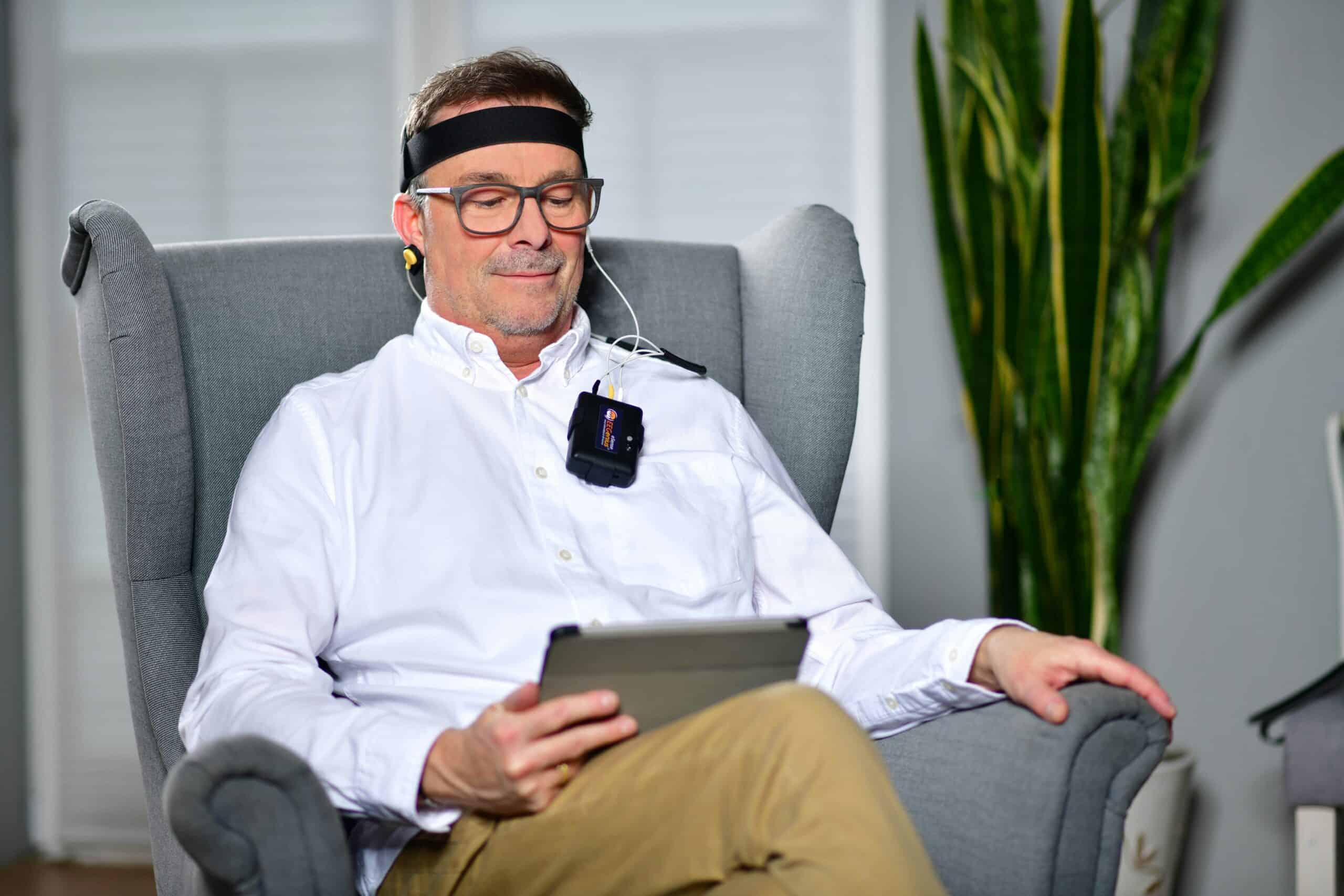
A biofeedback device measures something your body is doing without your awareness, shows it to you in real time, and lets you practice changing it. For migraine, the target is usually muscle tension, skin temperature, or heart rate variability, and the goal is learning to interrupt the stress response before it contributes to an attack.
This is one of the few complementary approaches with genuine backing behind it. The American Migraine Foundation describes biofeedback as a noninvasive mind-body therapy using electrical sensors to monitor functions like heart rate, blood pressure, breathing, and muscle tension, giving visual or sound cues that let you modify your body’s reactions as they happen.1 Research cited by AMF indicates behavioral therapies can reduce migraine by 35 to 50 percent, with effects similar to preventive medications.2
Medical Disclaimer
This article is general information and not medical advice. Biofeedback for migraine is most effective when learned with a trained clinician, and consumer devices are training tools rather than treatments. Talk to a doctor or headache specialist before adding anything to your migraine plan, and do not stop or change prescribed medication based on anything here.
Quick Verdict
An HRV sensor with a guided breathing app is the most practical entry point, because the training generalizes and the hardware is inexpensive. Temperature trainers are the traditional migraine approach and cost the least of all. Clinical-grade EMG systems belong in a practitioner’s office rather than a first purchase.
Key Points
- Biofeedback teaches a skill; the device is training equipment, not therapy in itself
- Behavioral therapies including biofeedback are among the better-supported non-drug options
- Hand-warming and EMG are the two approaches longest associated with headache work
- Results depend on regular practice over weeks, not on device sophistication
- Consumer devices differ from clinical systems in sensor quality and guidance
- Learning with a trained provider produces better outcomes than self-teaching
How We Picked
Measurement honesty came first. A device that reports a real physiological signal, and says which one, is doing biofeedback. Devices that display a vague wellness score without naming what is being sensed were set aside, because you cannot train against a number that does not correspond to anything.
Practice support was second. AMF notes that biofeedback and relaxation training are typically used together, with relaxation training involving a systematic set of procedures to slow the sympathetic nervous system.1 A device paired with structured guided sessions supports that; a bare sensor with a graph does not.
Claims were the third filter and removed several options. Nothing here is presented as a treatment for migraine, because that is not what these are. They are tools for learning a self-regulation skill that may form part of a plan built with a clinician.
1. The Heart Rate Variability Sensor
Why It Stands Out
HRV reflects the balance between the branches of your autonomic nervous system, and slow paced breathing shifts it measurably within minutes. That makes it the most responsive signal for a beginner, since you see the effect of what you are doing almost immediately, which is what keeps people practicing.
Worth Knowing
HRV varies with sleep, illness, caffeine, and time of day, so a single reading means little. The value is in the trend and in the practice itself rather than in any given number. Ear and finger clip sensors are generally steadier than wrist optical sensors for this purpose.
Right for a first device and for anyone who will practice most days. Skip it if you want a single number to interpret rather than a skill to build.
2. The Thermal Biofeedback Trainer
Why It Stands Out
Hand warming is the classic headache biofeedback approach. Peripheral skin temperature rises as the stress response settles, so a sensitive thermometer on a fingertip gives direct feedback on relaxation. The equipment is simple and among the least expensive ways to start.
Worth Knowing
Room temperature affects readings substantially, so sessions need consistent conditions to be comparable. Progress is slower to see than with HRV, and some people find the feedback too subtle to stay motivated without a practitioner guiding early sessions.
Right for the traditional approach at low cost. Skip it if you need faster visible feedback to stick with practice.
3. The EMG Muscle Tension Sensor
Why It Stands Out
Surface EMG measures electrical activity in muscle, typically at the forehead, jaw, or trapezius. For people whose attacks involve significant neck and shoulder tension, seeing that tension as a number makes an unconscious habit visible and therefore trainable.
Worth Knowing
Sensor placement changes readings considerably, and getting it consistent without training is difficult. This is the modality where working with a clinician matters most, and where consumer hardware differs most from clinical systems.
Right for tension-dominant patterns, ideally alongside professional guidance. Skip it as an unsupported first purchase.
4. The Guided Breathing Device
Why It Stands Out
These pace your breathing with light, sound, or haptic rhythm rather than measuring anything. Strictly they are relaxation trainers rather than biofeedback, but relaxation training is the other half of what AMF describes as the standard pairing, and a device that removes the need to count is genuinely easier to use daily.
Worth Knowing
Without a sensor there is no feedback loop, so you cannot tell whether your physiology is responding. Some people prefer that simplicity; others find the lack of confirmation makes practice feel pointless.
Right for daily relaxation practice with minimal friction. Skip it if you want to see a measured response.
5. The Multi-Sensor Home System
Why It Stands Out
Systems combining HRV, temperature, and sometimes EMG in one package let you work across modalities and find which signal you respond to. For someone committed to a structured programme at home, that flexibility is worth having.
Worth Knowing
More sensors mean more setup and more to interpret, which is exactly where self-directed users tend to give up. These also occupy the price range where several sessions with a trained provider become a realistic alternative, and those sessions produce better results for most people.
Right for committed users with clinician guidance. Skip it as a starting point.
6. The Wearable With HRV Tracking
Why It Stands Out
A ring or watch already on your body collects HRV continuously, which builds a long baseline without any deliberate effort. For spotting patterns across weeks, and for pairing physiological data with attack records, passive collection has real advantages.
Worth Knowing
Continuous tracking is monitoring, not training. Most wearables show data after the fact rather than in real time, which is what biofeedback requires. Treat it as a complement to a diary rather than as a biofeedback device.
Right for long-term pattern spotting alongside tracking. Skip it if real-time training is what you want.
How a Practice Session Actually Runs
Set a consistent time and place
Physiological signals shift with room temperature, posture, caffeine, and time of day. Practicing in the same chair at roughly the same hour removes most of that variation, so the changes you see reflect what you are doing rather than the conditions.
Establish a baseline before you try to change anything
Two or three quiet minutes with the sensor running, before any deliberate breathing or relaxation, gives you the starting point. Without it you have no way to judge whether a session did anything.
Work in short sessions
Ten to fifteen minutes most days does more than an hour once a week. The skill is built through repetition rather than duration, and short sessions are the ones people actually keep doing after the novelty passes.
Stop before frustration sets in
Straining to move a number activates the stress response you are trying to settle, which is why sessions that turn into a contest tend to go backwards. Ending a session early on a bad day is better practice than pushing through it.
Where This Fits in a Migraine Plan
Biofeedback sits in the preventive half of migraine management rather than the acute half. It does not replace medication, and AMF frames behavioral therapies as being used alongside acute and preventive treatment rather than instead of them.4
The people who get most from it tend to have a clear stress or tension component to their pattern, and the discipline to practice on days when nothing hurts. If your attacks are driven mainly by hormonal cycles, weather, or food, the return on this particular skill may be smaller, and identifying your actual trigger pattern is the more useful first step.
Tracking matters here too. Since improvement is gradual and measured in attack frequency rather than in how a session felt, a record kept over months is the only honest way to judge whether the practice is earning its time. That is a job for a diary or app kept consistently.
Biofeedback Devices at a Glance
| Type | Signal measured | Real-time feedback | Best for |
|---|---|---|---|
| HRV sensor | Heart rate variability | Yes | First device |
| Thermal trainer | Skin temperature | Yes | Traditional approach |
| EMG sensor | Muscle tension | Yes | Tension patterns |
| Guided breathing | None | No | Daily practice |
| Multi-sensor system | Several | Yes | Structured programmes |
| HRV wearable | Heart rate variability | Usually not | Pattern tracking |
What to Look For in a Biofeedback Device
Does it name what it measures?
A device should state its signal clearly: HRV, skin temperature, or muscle activity. Composite wellness scores without a stated physiological basis cannot be trained against in any meaningful way.
Is the feedback genuinely real time?
Biofeedback depends on seeing the response as it happens, which is what allows you to connect a change in what you are doing to a change in your body. Delayed summaries are monitoring, and they teach nothing.
Does it include structured practice?
Guided sessions matter more than sensor precision for a beginner. AMF describes biofeedback and relaxation training as typically used together to build body awareness and techniques for returning to a relaxed state.1 A device without that structure leaves you to invent the programme yourself.
Would a clinician be the better first step?
For many people, several sessions with a provider trained in behavioral headache management produce better results than any consumer device used alone. That is worth pricing against the hardware before buying.
Biofeedback vs Relaxation Training
How they differ
Biofeedback measures a physiological signal and shows it to you. Relaxation training teaches procedures to slow the sympathetic nervous system without measuring anything. AMF describes them as commonly used together rather than as alternatives.1
Which to start with
Relaxation training needs no equipment and can begin immediately. Adding a sensor later tells you whether what you are practicing is producing a measurable change, which for some people is what makes the habit stick. Related approaches appear in choosing tension relief methods.
What Trips People Up
Expecting a device to stop an attack
Biofeedback is a preventive skill built over weeks. It is not an acute treatment, and reaching for a sensor during an attack is not how it works.
Practicing only when stressed
The skill is learned in calm conditions and then applied under pressure. Practicing only when you already feel bad is like learning to swim during a flood.
Chasing the number
HRV in particular fluctuates with sleep, illness, and caffeine. Treating a single low reading as meaningful produces anxiety, which is the opposite of the intended effect.
Skipping professional instruction
The evidence base largely rests on clinician-guided programmes. Self-directed use of consumer hardware is not the same thing, and it is fair to expect less from it.
Recommended Reading
- assembling a practical migraine toolkit
- how stress contributes to attacks
- finding a specialist for behavioral approaches
- TENS devices and how they differ
- apps for recording what you observe
- the trigger picture behind prevention
- sleep habits that support prevention
- wearable relief bands and how they compare
Frequently Asked Questions
Does biofeedback actually help migraine?
Research cited by the American Migraine Foundation indicates behavioral therapies, which include biofeedback, can reduce migraine by 35 to 50 percent, with effects comparable to preventive medications.2 Results depend on consistent practice, and clinician-guided programmes have the stronger evidence behind them.
How long before biofeedback works?
It is a learned skill rather than a treatment with an onset, so weeks of regular practice is a realistic expectation rather than days. Most structured programmes run over several weeks with sessions between appointments.
Is a consumer device as good as clinical biofeedback?
Generally not. Clinical systems use higher-grade sensors, and more importantly a trained provider guides placement, interpretation, and the training programme. Consumer devices are best understood as practice tools between or after professional sessions.
Can biofeedback stop a migraine once it starts?
It is a preventive skill, not an acute treatment. Some people find relaxation techniques help them cope during an attack, but that is different from aborting one, and acute treatment should be discussed with your doctor.
Do I need a subscription?
Many consumer devices pair with apps that gate guided programmes behind a subscription. Since the guided practice is the part that matters most, price the subscription alongside the hardware rather than after buying it.
Is biofeedback safe?
Biofeedback itself is noninvasive and generally considered low risk. The main caution is treating it as a replacement for medical care. Anyone with a pacemaker or implanted device should confirm compatibility with any electrical sensor before use.
Can children use biofeedback for migraine?
Behavioral approaches are used in pediatric headache care, and the American Headache Society notes behavioral treatments can benefit anyone with migraine, especially children.4 Any programme for a child should be set up through their doctor or a headache specialist rather than assembled at home.
Will insurance cover clinical biofeedback?
Coverage varies considerably by plan and by how the sessions are coded, and some plans cover it under behavioral health rather than neurology. It is worth asking your provider directly before assuming a consumer device is the only affordable route.
When should I see a doctor instead?
If attacks are increasing in frequency or severity, if your usual treatment is no longer working, if you are using acute medication frequently, or if you have new or unusual symptoms, see a doctor before adding anything new. A headache specialist can also tell you whether behavioral therapy fits your situation.
Sources
- American Migraine Foundation, “5 Common Alternative Treatments for Migraine.” https://americanmigrainefoundation.org/resource-library/common-alternative-treatments-migraine/
- American Migraine Foundation, “Alternative Migraine Treatments.” https://americanmigrainefoundation.org/resource-library/alternative-treatments-migraine/
- American Migraine Foundation, “Biofeedback and Relaxation Training for Headache.” https://americanmigrainefoundation.org/resource-library/biofeedback-and-relaxation-training/
- American Headache Society, “Behavioral Treatment for Migraine.” https://americanheadachesociety.org/resources/primary-care/behavioral-treatment-for-migraine
