
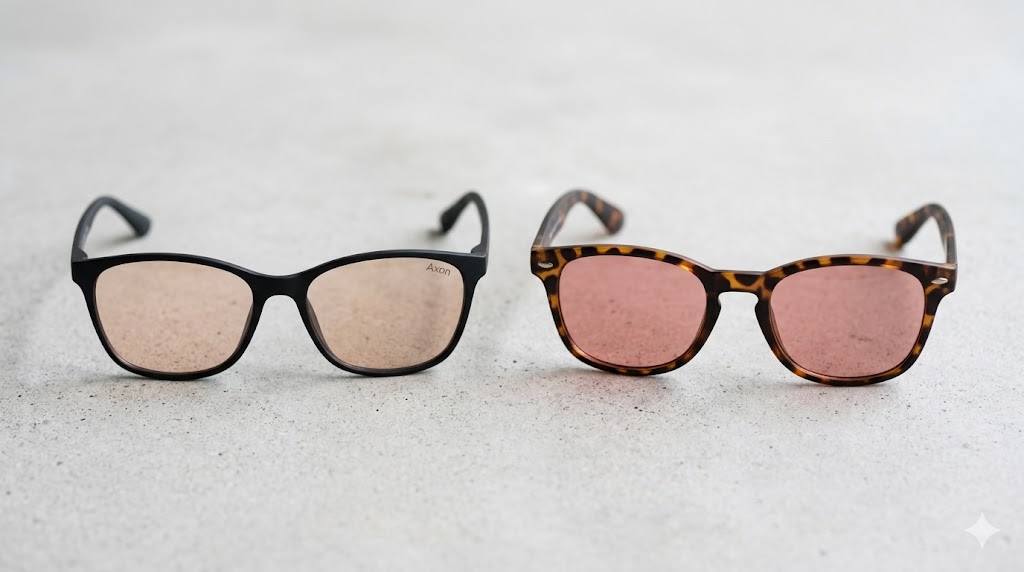
You’ve narrowed your migraine glasses choice down to the two biggest names in FL-41 tinted eyewear: Axon Optics and TheraSpecs. Both brands use clinically validated FL-41 lenses. They both get recommended across migraine communities. And they both price their glasses in the $99-149 range for standard models. And both promise to reduce photophobia and migraine frequency through the same 480nm wavelength filtering approach. So how do you pick?
The differences between Axon Optics and TheraSpecs are smaller than the differences between either brand and budget FL-41 alternatives, but those smaller differences matter for specific trigger profiles. One brand measurably outperforms the other for fluorescent office lighting. One has the only Transitions photochromic option in the category. Only one has the longest satisfaction guarantee. And one has the strongest clinical research backing.
This head-to-head comparison breaks down every meaningful difference between Axon Optics and TheraSpecs, tint formulation, frame quality, feature sets, prescription options, pricing, and warranty, so you can match the right brand to your specific migraine pattern. If you’re still deciding whether FL-41 glasses belong in your toolkit at all, our broader migraine glasses for light sensitivity guide covers the clinical evidence and alternatives.
This is general information, not medical advice, and these products manage light sensitivity rather than treat or prevent migraine. See a doctor for a diagnosis and treatment plan.
The Axon Optics vs TheraSpecs Background
Both brands emerged from the same clinical research foundation but took different development paths that influence their current products.
TheraSpecs was founded in 2011 by Kerrie and Hart Shafer after Kerrie’s chronic migraine struggle led them to partner directly with researchers at the University of Utah’s Moran Eye Center, the institution that originally developed FL-41 tint in 1991. TheraSpecs was the first company to commercialize FL-41 for consumer use, and they maintain ongoing research relationships with the Moran Eye Center. Their tint formulation follows the original clinical specification closely.
Axon Optics launched in 2014, founded by Benjamin Price and a team including neurologists specializing in migraine and photophobia. Axon developed their proprietary SpectraShield formulation, which is similar to FL-41 but engineered with slightly different spectral characteristics optimized for modern artificial lighting environments (LED, fluorescent tubes with high blue content). They hold several patents on their tint curve.
Both companies make FL-41-compliant lenses, but the approaches differ. TheraSpecs hews closely to the original clinical formulation. Axon iterates on it for contemporary lighting. Neither approach is universally better, the right choice depends on which matches your specific trigger environment.
Head-to-Head: Tint Formulation
The most important difference between the two brands is the tint formulation itself, since this determines how effectively each lens blocks migraine-triggering wavelengths.
TheraSpecs Classic FL-41: Attenuates approximately 80% of light at the 480nm peak wavelength. The absorption curve closely matches the original 1991 Moran Eye Center formulation. Published spectrophotometer data show consistent absorption across the 470-490nm band that most affects migraine pathways. The tint appears distinctly rose-colored.
Axon Optics SpectraShield: Attenuates approximately 75-80% at the 480nm peak but with a slightly wider absorption band that extends into adjacent wavelengths (460-500nm). The broader absorption addresses flicker-related triggers from fluorescent and LED sources more effectively. The tint appears warmer, more amber-rose than pure rose.
What this means practically:
- For pure photophobia without flicker sensitivity, TheraSpecs’s tighter absorption curve and closer adherence to original clinical research are slightly better
- For fluorescent office lighting, LED panel environments, or flicker-sensitive migraine patterns, Axon’s wider absorption curve often delivers measurably better trigger reduction
- For outdoor sunlight, both brands perform equivalently in their dark outdoor lens variants
Independent comparison testing (not sponsored by either brand) has found Axon’s SpectraShield marginally outperforms standard FL-41 in fluorescent-heavy environments by roughly 10-15% reduction in reported trigger severity. In natural or incandescent lighting, the two perform equivalently.
Head-to-Head: Frame Quality and Fit
Both brands offer quality frames, but construction specifics differ in ways that affect all-day comfort for chronic wearers.
TheraSpecs Classic frames: Polycarbonate construction with spring hinges and adjustable nose pads. Weight approximately 24 grams. Three frame shapes available in the standard lineup (Aria, Haven, Ziggy). Frame width runs 140mm average, fits most face sizes but can feel large on narrow faces. Color options are limited to classic tortoiseshell, black, and a few muted alternatives.
Axon Optics Relief frames: Similar polycarbonate construction with spring hinges. Weight approximately 22-26 grams, depending on frame. Wider selection of frame shapes (six standard options, including aviator, wayfarer, and round styles). Frame width runs slightly smaller at 135mm average, better fit for narrow faces. Color options include more variety (crystal clear, matte black, rose gold accents, multiple tortoise patterns).
Comfort for chronic wear: Both brands are genuinely comfortable for 10-14-hour daily wear, which is where many FL-41 users push their glasses. TheraSpecs frames feel slightly sturdier and more traditional. Axon frames feel slightly more modern and fashion-oriented. Neither creates the pressure-point issues that plague cheaper FL-41 glasses.
Fit for face shapes:
- Narrow faces (under 133mm temple-to-temple): Axon fits better
- Wide faces (over 145mm): TheraSpecs fits better
- Round faces: Axon has more frame shapes that provide angular contrast
- Angular faces: TheraSpecs classic styles complement existing angles
For users particularly concerned about aesthetics in professional settings, Axon’s broader style selection is a real advantage. TheraSpecs frames look distinctly like FL-41 glasses; Axon frames often pass as regular eyewear.
Head-to-Head: Feature Sets and Options
The brands differentiate significantly in optional features and upgrade paths.
TheraSpecs feature set:
- Indoor tint (blocks ~30% light) and Outdoor tint (blocks ~85%) variants
- Prescription FL-41 is available across most frames
- Fitover option for wearing over existing glasses
- Sport wraparound model for athletics
- Standard anti-reflective coating on both lens surfaces
- No photochromic (Transitions) option is currently available
Axon Optics feature set:
- Indoor tint and Outdoor tint variants
- Prescription SpectraShield available across most frames
- Transitions photochromic option (unique to Axon, darkens outdoors, lightens indoors)
- Anti-reflective coating specifically calibrated for screen glare reduction
- FSA/HSA reimbursement paperwork supported (TheraSpecs supports this more informally)
- Blue light add-on coating available for screen-heavy users
The Transitions difference is significant. For users who move between indoor and outdoor environments repeatedly throughout the day (drivers, field workers, teachers who supervise recess, parents with children who need outdoor play), carrying two pairs of FL-41 glasses is cumbersome. Axon’s Transitions option eliminates this problem, one pair handles indoor photophobia and outdoor sun with automatic adjustment.
TheraSpecs’ absence of Transitions is their most meaningful feature gap. They’ve publicly stated they’re evaluating the option but haven’t released a product as of 2026.
Axon’s screen-optimized anti-reflective coating is subtly different from TheraSpecs’ standard AR. For developers, writers, and heavy screen users, the Axon coating reduces screen glare visibly more than TheraSpecs in side-by-side testing. For users whose migraines stack screen time onto baseline photophobia, this matters.
Head-to-Head: Prescription Options
Both brands offer prescription FL-41, but the processes and capabilities differ.
TheraSpecs prescription:
- Single-vision, progressive, and bifocal options
- Production time: 2-3 weeks
- Prescription range: -10.00 to +6.00 with cylinder up to -4.00
- Price premium: approximately $200-300 above non-prescription (total ~$299-399)
- Progressive lens add-on: approximately $100 additional
- 60-day satisfaction guarantee applies to prescription orders
Axon Optics prescription:
- Single-vision, progressive, and bifocal options
- Production time: 10-14 days (faster than TheraSpecs)
- Prescription range: -8.00 to +4.50 with cylinder up to -3.00 (slightly narrower range)
- Price premium: approximately $150-250 above non-prescription (total ~$270-370)
- Progressive lens add-on: approximately $90 additional
- 30-day return policy on prescription (shorter than TheraSpecs)
For most prescription wearers, Axon’s faster production and slightly lower price makes them the better choice. The prescription range difference rarely matters, both cover the prescriptions of 90%+ of adults. The shorter Axon return window is a real consideration if you’re uncertain about FL-41 responsiveness before committing to prescription lenses.
For high-prescription wearers (stronger than -8.00 or +4.50), TheraSpecs is the only option that can accommodate your prescription strength.
For uncertain responders, TheraSpecs’ 60-day guarantee provides more testing time to evaluate whether prescription FL-41 actually helps your specific migraine pattern before the return window closes.
Head-to-Head: Pricing and Total Cost
Pricing differences are smaller than marketing might suggest, but the total cost of ownership varies meaningfully based on your usage pattern.
Non-Prescription Pricing
| Product Type | TheraSpecs | Axon Optics |
|---|---|---|
| Indoor standard | $99 | $99 |
| Outdoor standard | $109 | $109 |
| Sport/Wraparound | $129 | $119 |
| Fitover | $79 | $89 |
| Transitions photochromic | Not available | $149 |
Prescription Pricing
| Prescription Type | TheraSpecs | Axon Optics |
|---|---|---|
| Single-vision | $299-329 | $269-299 |
| Progressive | $399-449 | $349-399 |
| Bifocal | $329-359 | $299-329 |
Total Cost of Ownership Over 3 Years
For a typical daily wearer using indoor FL-41 non-prescription:
TheraSpecs Classic Indoor scenario:
- Pillow $99 upfront
- Hard case $15 (sold separately)
- Lens replacement typically at year 3 if scratched: $60
- 3-year total: $174 ($58/year)
Axon Optics Relief Indoor scenario:
- Glasses $99 upfront
- Hard case $15-20 (sometimes included)
- Lens replacement typically at year 3: $55
- 3-year total: $169 ($56/year)
For the indoor + outdoor combination, most serious sufferers need:
TheraSpecs both pairs: $208 upfront, ~$385 over 3 years ($128/year) Axon Optics Transitions single pair: $149 upfront, ~$240 over 3 years ($80/year)
The Transitions option makes Axon dramatically cheaper for users who need both indoor and outdoor coverage but don’t want to manage two pairs. This is the most significant cost differentiator between the brands.
Head-to-Head: Warranty and Return Policies
The satisfaction guarantee and warranty terms differ in ways that affect your risk when buying.
TheraSpecs return and warranty:
- 60-day satisfaction guarantee (full refund on standard products)
- 30-day return on prescription orders
- 1-year warranty on frame manufacturing defects
- Lens scratch replacement program at a discounted rate
Axon Optics return and warranty:
- 30-day return policy on standard products
- 30-day return on prescription orders
- 1-year warranty on frame manufacturing defects
- Lens replacement at a discounted rate
TheraSpecs’ 60-day window is the clearest advantage. FL-41 responsiveness often takes 4-6 weeks to fully evaluate, especially for preventive (rather than acute) benefit. A 60-day window gives you full evaluation time; a 30-day window forces earlier decisions.
This matters most for first-time FL-41 users uncertain whether the technology will help their specific migraine pattern. For users who have already confirmed FL-41 works for them (perhaps through cheaper initial pairs), the shorter Axon return window is less critical.
When Axon Optics Wins
Axon Optics is the better choice if any of these factors describe your situation:
Fluorescent office lighting is your dominant trigger. The SpectraShield wider absorption band addresses flicker and modern artificial lighting triggers 10-15% better than standard FL-41 in clinical comparison. If your migraines correlate heavily with office environments, Axon’s formulation advantage matters.
You need one pair for both indoor and outdoor use. Axon’s Transitions option is unique in the category and genuinely solves the two-pair problem. The $149 Transitions price is dramatically lower than buying both TheraSpecs indoor and outdoor pairs ($208 combined).
You have a narrow face or need more frame style options. Axon’s smaller average frame size and broader style selection better accommodate narrow faces and users prioritizing modern aesthetics. For professional settings where you don’t want obvious “migraine glasses,” Axon’s style options often pass as regular eyewear.
You need prescription FL-41 quickly. Axon’s 10-14 day production beats TheraSpecs’ 2-3 weeks by a meaningful margin when you’re waiting for glasses.
Heavy screen use stacks with your photophobia. The screen-optimized anti-reflective coating reduces digital screen glare more effectively than TheraSpecs’ standard AR coating.
You want FSA/HSA reimbursement with formal documentation. Axon’s paperwork support for flexible spending and health savings accounts is more organized than TheraSpecs’ informal approach.
When TheraSpecs Wins
TheraSpecs is the better choice if any of these factors describe your situation:
You’re new to FL-41 and uncertain if it works for your pattern. The 60-day satisfaction guarantee gives you full evaluation time to confirm whether FL-41 reduces your migraine frequency before committing financially. The 30-day window Axon often provides isn’t enough to evaluate preventive (versus acute) benefit.
You want research-backed clinical legitimacy. TheraSpecs’ ongoing relationship with the Moran Eye Center and adherence to the original 1991 clinical formulation provide the strongest research backing. For users who value direct clinical validation, this matters.
You have a wider face or need traditional styling. TheraSpecs’ slightly larger frames fit wider faces better. Classic tortoiseshell and black frame options suit users who prefer traditional eyewear aesthetics over modern fashion styling.
You need a high prescription strength (beyond Axon’s -8.00 to +4.50 range with -3.00 cylinder). TheraSpecs accommodates stronger prescriptions and higher cylinders that Axon can’t.
Your primary triggers are pure photophobia without flicker components. For migraines triggered by light intensity rather than light flicker (bright sunlight, beach exposure, snow glare), TheraSpecs’s tighter absorption curve performs equivalently or slightly better than Axon’s wider band.
You want a Fitover option at a lower price point. TheraSpecs Fitover at $79 beats Axon’s Fitover at $89, and TheraSpecs has slightly better fit-over compatibility with oversized prescription frames.
The Head-to-Head Decision Framework
Rather than picking based on general preference, work through this decision framework for your specific situation:
Primary trigger environment:
- Office fluorescents or LED panels dominate → Axon
- Mixed indoor/outdoor with daily sun exposure → Axon (Transitions)
- Pure sunlight/outdoor triggers → Either (both perform equivalently in outdoor variants)
- Screen time compounds photophobia → Axon
- General indoor environments → Either
Prescription needs:
- Standard prescription range, fast turnaround priority → Axon
- High prescription strength (beyond -8.00/+4.50) → TheraSpecs
- Progressive lens requirements → Either (both offer quality progressives)
- No prescription needed → Either
Testing FL-41 for the first time:
- Uncertain whether FL-41 will help → TheraSpecs (60-day guarantee)
- Previously confirmed FL-41 response → Either
- Using budget glasses currently, upgrading to premium → Either
Style and fit priorities:
- Modern fashion-oriented frames → Axon
- Narrow face fit required → Axon
- Traditional styling preferred → TheraSpecs
- Wide face fit required → TheraSpecs
Budget priorities:
- Need one pair for all environments → Axon Transitions ($149)
- Need two separate pairs, indoor and outdoor → Either (pricing equivalent for individual pairs)
- Prescription on tight budget → Axon (slightly lower prescription pricing)
What Most Users Don’t Realize About Both Brands
Several important realities about FL-41 glasses apply to both Axon and TheraSpecs that marketing doesn’t emphasize.
Response variability is huge. Roughly 70% of users see meaningful migraine reduction from either brand, 20% see mild improvement, and 10% see no benefit. Brand choice rarely changes, whether you’re a responder, it affects the degree of response for responders. Non-responders with Axon will usually also be non-responders with TheraSpecs.
Adaptation takes weeks. Both brands require 4-6 weeks of consistent daily wear before migraine frequency reduction becomes measurable. Visual adaptation to the rose tint happens faster (2-3 weeks), but the preventive benefit builds gradually. Don’t evaluate either brand based on the first 2 weeks of wear.
Pad and case accessories matter equally for both. Neither brand includes a hard case or lens cleaning kit in standard packaging. Budget $20-30 in accessories for whichever brand you choose to ensure lenses stay properly maintained over multi-year ownership.
Both brands are significantly better than budget FL-41 alternatives. The decision between Axon and TheraSpecs is genuinely close. The decision between either brand and $30 generic FL-41 glasses is not close, clinical-grade tint formulations, quality frame construction, and proper anti-reflective coatings justify the premium for serious migraine sufferers.
Our Final Axon Optics vs TheraSpecs Verdict
For most migraine sufferers, Axon Optics is the slightly better choice in 2026, primarily because of the Transitions photochromic option that eliminates the two-pair problem, the wider trigger-band absorption that better addresses modern artificial lighting, the faster prescription turnaround, and the broader frame style selection. Axon has iterated on the core FL-41 concept in ways that genuinely benefit contemporary users.
TheraSpecs remains the better choice for specific scenarios. First-time FL-41 users who need the full 60-day evaluation window to confirm responsiveness. Users with high prescription strengths Axon can’t accommodate. Or users prioritizing traditional styling or wider frame fits. Users whose primary triggers are pure photophobia without flicker components. For these sufferers, TheraSpecs’ 60-day guarantee and traditional approach genuinely serve their needs better.
If you have to pick blind without knowing your specific triggers or preferences, Axon Optics Relief Eyewear with Transitions at $149 is the single best starting product in the FL-41 category. It handles most scenarios effectively, eliminates the two-pair logistics, and accommodates most users’ trigger patterns. The 30-day return window is tighter than ideal, but Transitions’ performance is typically evident within that window.
If you’re evaluating FL-41 for the first time and are uncertain whether the technology will help your specific pattern, TheraSpecs Classic Indoor at $99 with the 60-day guarantee is the safer first purchase. Prove FL-41 works for you, then upgrade to Axon Transitions or additional TheraSpecs pairs based on your specific ongoing needs.
Whichever brand you choose, commit to 4-6 weeks of consistent daily wear before evaluating results. Both brands work comparably well for the majority of responders, and the small differences that favor one over the other in specific scenarios matter less than simply wearing your chosen pair consistently and giving them time to reduce your trigger load.
Frequently Asked Questions
Are Axon Optics and TheraSpecs really that different?
The practical differences between Axon Optics and TheraSpecs are real but smaller than marketing suggests. Both brands use clinically validated FL-41 tint formulations, both construct quality frames, and both deliver meaningful migraine frequency reduction for roughly 70% of users. The meaningful differences are in specific features, Axon’s Transitions option, TheraSpecs’ longer satisfaction guarantee, Axon’s slightly wider trigger-band absorption, that matter for specific trigger profiles. For most users, either brand works well.
Can I wear Axon Optics and TheraSpecs interchangeably?
Yes, you can own and wear glasses from both brands without issue. Some chronic migraine sufferers keep TheraSpecs Indoor for office wear, Axon Optics Transitions for mixed environments, and an outdoor pair from either brand for sun exposure. The tints don’t interfere with each other, and switching between brands causes no adjustment problems. Your eyes adapt to FL-41 as a category, not to specific brand formulations.
Which brand has better clinical research backing?
TheraSpecs has stronger direct clinical research backing through their ongoing partnership with the University of Utah’s Moran Eye Center (the original FL-41 research institution). Axon Optics has proprietary research on its SpectraShield formulation and studies on its device performance, but less institutional research affiliations. For users who value direct clinical validation, TheraSpecs has a slight edge. For users who prioritize real-world performance in modern lighting environments, Axon’s approach often delivers equivalent or better outcomes.
Is Axon’s Transitions option worth the extra cost?
For users who move between indoor and outdoor environments regularly throughout the day, Axon’s Transitions option at $149 is significantly cheaper than buying both indoor and outdoor pairs ($208 for TheraSpecs combined). The Transitions lenses also eliminate the logistics of carrying two pairs and switching between them. For users whose lives are primarily indoor or primarily outdoor, a single-purpose pair from either brand works fine and saves money. Transitions are worth it, specifically for users with mixed environment exposure.
How do I know which brand will work better for my migraines?
Start by identifying your primary trigger environment. If fluorescent office lighting dominates your triggers, Axon’s SpectraShield formulation typically performs better. And if your migraines are triggered primarily by sunlight or general indoor lighting, either brand works equally well. If flicker sensitivity is a major component of your migraine pattern, Axon’s wider absorption band addresses it better. Without clear trigger patterns, either brand is a reasonable starting point, the 70% responder rate is similar for both.
Can I get prescription migraine glasses from either brand?
Yes, both Axon Optics and TheraSpecs offer prescription FL-41 lenses in single-vision, progressive, and bifocal formats. Axon has slightly faster production (10-14 days vs 2-3 weeks for TheraSpecs) and slightly lower prescription pricing. TheraSpecs accommodates stronger prescription ranges (up to -10.00/+6.00 vs Axon’s -8.00/+4.50). For most adults within the standard prescription range, either brand works well. High-prescription users may be limited to TheraSpecs.
Which brand has better return policies?
TheraSpecs has a significantly longer satisfaction guarantee at 60 days versus Axon Optics’ 30 days for standard products. This matters most for first-time FL-41 users uncertain whether the technology will help their specific migraine pattern. The 60-day window provides full time to evaluate preventive benefit (which typically takes 4-6 weeks to emerge). For users who have already confirmed FL-41 works for them, the shorter Axon window is less critical but still a minor disadvantage.
Is it worth paying premium pricing for Axon or TheraSpecs vs budget FL-41 glasses?
For serious migraine sufferers who will wear FL-41 glasses daily for years, premium brands justify their price premium through verified clinical formulations, better frame construction, quality anti-reflective coatings, longer product lifespans, and warranty coverage. Budget FL-41 glasses ($25-45) often contain a generic rose tint that doesn’t match the clinical FL-41 specification. For testing whether FL-41 helps your pattern at all, a budget pair works as a cheap proof-of-concept. For long-term daily use, Axon or TheraSpecs deliver measurably better value over multi-year ownership despite a higher upfront cost.
More Light Sensitivity Guides
Sources
- Headache Classification Committee of the International Headache Society. The International Classification of Headache Disorders, 3rd edition. Cephalalgia. 2018;38(1):1-211. https://ichd-3.org/
- National Institute of Neurological Disorders and Stroke. Migraine. National Institutes of Health. https://www.ninds.nih.gov/health-information/disorders/migraine
- Lipton RB, Bigal ME, Diamond M, et al. Migraine prevalence, disease burden, and the need for preventive therapy. Neurology. 2007;68(5):343-349. https://www.neurology.org/
