
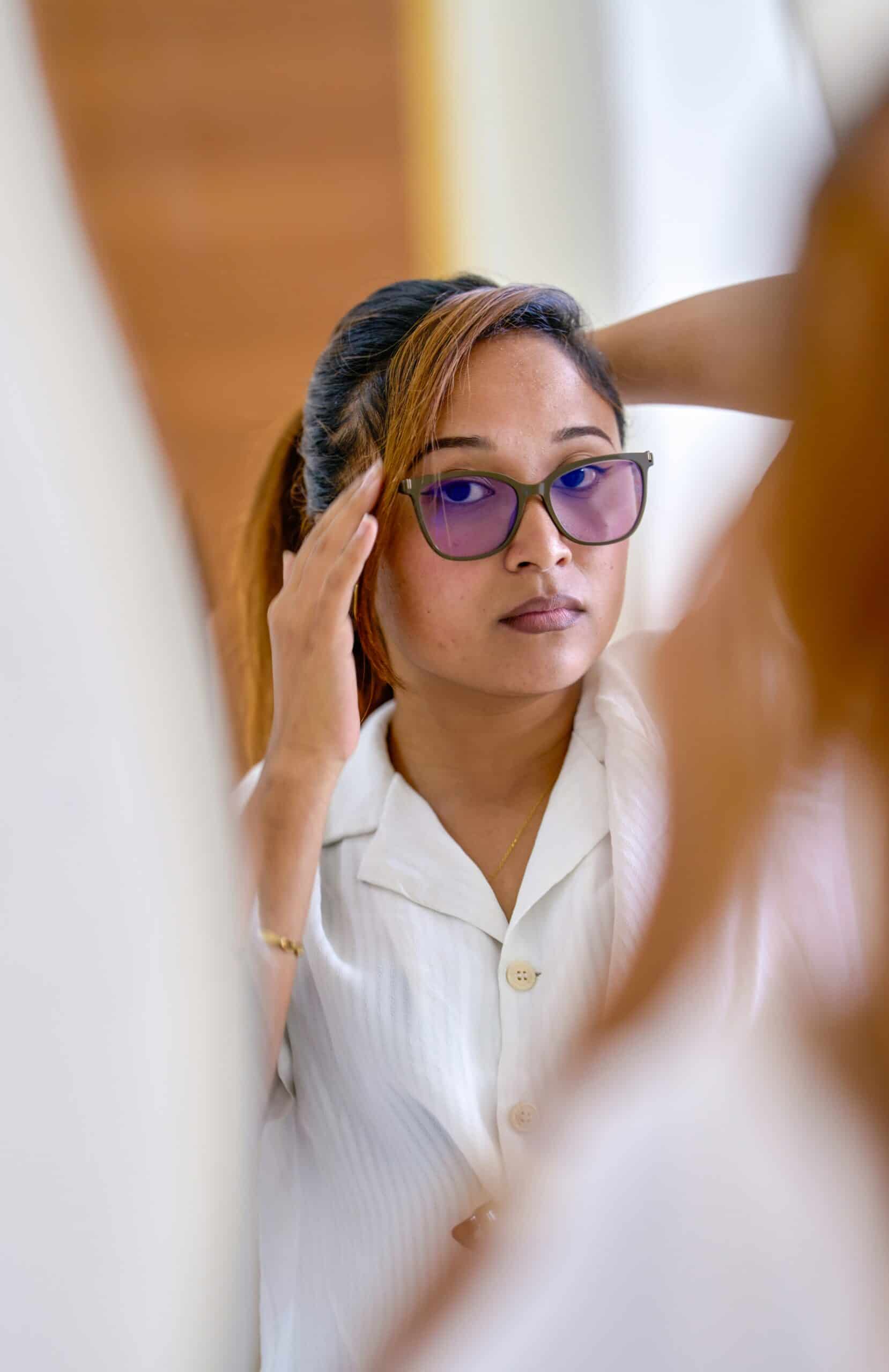
You step into the grocery store, and the fluorescent lights feel like a knife. Your eyes water, your temples tighten, and you know, another migraine is starting. For people with chronic photophobia, this cycle is exhausting. TheraSpecs have become the go-to brand name in FL-41 tinted eyewear because they actually work, with clinical research backing them and thousands of real users reporting reduced migraine frequency after consistent wear.
But TheraSpecs offers multiple models, and they’re not interchangeable. The Classic, Outdoor, Fitover, Sport, and Prescription versions each serve different trigger patterns, lifestyles, and budgets. Choosing the wrong one means spending $99 or more on eyewear that doesn’t match your actual needs.
This guide compares the five most popular TheraSpecs models to help you match the right pair to your specific photophobia pattern. Whether you battle office fluorescents, outdoor glare, wear prescription lenses, or need athletic coverage, there’s a model below built for your life.
This is general information, not medical advice, and these products manage light sensitivity rather than treat or prevent migraine. See a doctor for a diagnosis and treatment plan.
Why TheraSpecs for Photophobia Works Better Than Regular Tinted Glasses
TheraSpecs’ reputation isn’t marketing, it’s chemistry. The brand was founded in 2011 by a couple whose personal struggle with chronic migraines led them to partner directly with researchers at the University of Utah’s Moran Eye Center, the same institution that originally developed FL-41 tint in 1991. That partnership gave TheraSpecs access to the precise spectral absorption curve that defines true FL-41, not a generic rose tint.
The 480-nanometer wavelength, the blue-green band most connected to migraine pathways in the brain, gets absorbed at roughly 80% by genuine FL-41 lenses. TheraSpecs publishes their actual spectrophotometer data showing this absorption curve, which generic “migraine glasses” brands rarely do. When you see “FL-41-like” or “similar to FL-41” on a product page, that’s a signal the brand hasn’t matched the clinical specification.
This matters because photophobia isn’t about overall brightness. A dim room under LED lighting can trigger migraines in sensitive individuals, while a bright outdoor scene filtered through proper FL-41 may not. Targeting the specific trigger wavelength, rather than blocking all light uniformly, is what separates effective migraine glasses from tinted placebos. If you’re still evaluating whether FL-41 is right for you generally, our broader guide on migraine glasses for light sensitivity compares TheraSpecs against other brands.
What to Look for When Choosing TheraSpecs for Photophobia
All TheraSpecs models use the same clinically validated FL-41 tint formulation, so lens quality is consistent across the line. The real decision is which model fits your specific trigger environment and life patterns.
Indoor vs. Outdoor Tint Strength
Indoor TheraSpecs block approximately 30% of overall light, comfortable for offices, homes, and stores. Outdoor models block roughly 85%, equivalent to dark sunglasses. Wearing indoor lenses outside leaves you underprotected against sun-triggered migraines, and wearing outdoor lenses inside makes rooms feel uncomfortably dark. Most serious migraine sufferers own both.
Frame Coverage and Wraparound Design
Light that reaches your eyes from the sides, overhead fluorescents, car side windows, screen glare from the peripheral visual field, contributes to migraine triggers just like direct frontal light. TheraSpecs Sport models include pronounced wraparound coverage. The Classic has a subtle wrap. The Fitover covers the most area of any model because it wraps around your existing glasses.
Prescription Compatibility
If you already wear corrective lenses, you have three TheraSpecs paths: prescription FL-41 lenses custom-ground to your script (highest quality, 2-3 week production), Fitover frames that wrap around your current glasses (immediate, bulkier), or clip-ons that attach to your existing frames (cheapest, least coverage).
All-Day Comfort for Chronic Wear
Chronic migraine sufferers often wear these glasses 10-14 hours daily. Spring hinges, adjustable nose pads, lightweight materials, and weights under 25 grams prevent the pressure points and temple soreness that can themselves trigger tension headaches. Heavier frames become painful over long sessions.
Coating Quality and Lens Durability
All TheraSpecs lenses include anti-reflective coating on both surfaces, which prevents rose-halo glare around light sources. They also include anti-scratch and oleophobic (oil-resistant) coatings. Expect 2-3 years of daily-wear lifespan before replacement, longer than most prescription eyewear.
Best TheraSpecs for Photophobia in 2026: Our Top 5 Picks
1. TheraSpecs Classic Indoor, Best Overall TheraSpecs for Photophobia
Best Overall | Price: ~$99
The Classic Indoor is the model that built TheraSpecs’ reputation. Designed for office lighting, household LEDs, and general indoor wear, these block 30% of total light while attenuating 80% of the 480nm trigger band. For most migraine sufferers whose primary triggers happen indoors, fluorescent offices, supermarket aisles, medical waiting rooms, this is the only pair you need.
Best for: First-time TheraSpecs buyers, office workers, and anyone with moderate-to-severe photophobia who spends most waking hours indoors.
Why the Classic Indoor Sets the Standard
The lens geometry includes a slight wraparound that blocks peripheral light from overhead fluorescents without looking like athletic eyewear. The frame is a lightweight polycarbonate construction at just 24 grams, comfortable for 12+ hours of continuous wear. Spring hinges prevent pressure on the temples, which matters because temple pressure can itself trigger tension-type headaches.
Anti-reflective coating on both lens surfaces eliminates a subtle but real problem with cheaper FL-41 glasses, interior rose halos around light sources. Without proper interior AR coating, you’ll see a faint pink glow around every overhead light, which your brain processes as visual noise and can worsen migraine symptoms over time.
The 60-day satisfaction guarantee is the feature that tips this into our top spot. FL-41 response varies between individuals, about 70% of migraine sufferers see meaningful benefit, 20% mild benefit, 10% none at all. A real money-back window lets you discover which group you’re in without financial risk.
Total cost of ownership: $99 base plus $15 for a hard case (sold separately). Realistic 2.5-3 year lifespan with daily wear puts annualized cost at $35-40. Compared against the cost of just 2-3 prevented migraine attacks annually (lost workdays, triptans, urgent care), this pays back quickly.
PROS:
- Clinically validated FL-41 formulation at full strength
- Both-sided anti-reflective coating eliminates halos
- Lightweight polycarbonate (24g) for all-day wear
- Spring hinges prevent temple pressure
- 60-day satisfaction guarantee
- Prescription version available
CONS:
- Higher upfront cost than generic brands
- Hard case sold separately
- Rose tint needs 5-10 days to visually adapt to
- Only 3 frame shapes available
2. TheraSpecs Outdoor, Best TheraSpecs for Sunlight and Driving
Best for Outdoors | Price: ~$109
For migraine sufferers triggered by sunlight, driving, or reflective surfaces like snow and water, regular sunglasses consistently fall short. They block brightness uniformly but don’t filter the specific wavelengths responsible for photophobia attacks. TheraSpecs Outdoor combines deep FL-41 tint with sunglass-level darkness, solving both problems in one pair.
Best for: Drivers with sun-triggered migraines, outdoor workers, skiers and snow-exposed users, and anyone whose worst attacks come from direct sunlight or high-glare environments.
Why Regular Sunglasses Fail for Migraine Sufferers
Polarized sunglasses reduce glare from horizontal surfaces like water and roads, which is useful for general comfort. But polarization doesn’t address wavelength. A driver with migraine-sensitive triggers can wear $300 premium sunglasses and still trigger an attack from dashboard sun reflections, because the 480nm wavelength passes through polarization filters unchanged.
TheraSpecs Outdoor blocks 85% of total visible light while maintaining the FL-41 absorption curve at the trigger wavelength. The wraparound geometry is significantly more pronounced than the Indoor Classic, blocking peripheral sunlight from side windows during driving or from angled sun during outdoor work. For drivers specifically, this peripheral coverage is critical, sun coming through a side window can trigger attacks even when you’re looking forward.
The optional polarized upgrade ($20 additional) handles horizontal-surface glare on top of FL-41 wavelength filtering. For most outdoor triggers you want both defenses, so this upgrade is usually worth it. Snow and beach environments in particular benefit from the combination.
Total cost of ownership: $109 base, $129 with polarization, plus $15 for a hard case. Outdoor tint shows less visible scratching than indoor because darker lenses hide surface wear, pushing expected lifespan to 3+ years. Annualized cost: $35-45.
PROS:
- Deep FL-41 plus full sunglass darkness
- Pronounced wraparound blocks peripheral sun
- Polarization option for drivers and water sports
- Longer lifespan than indoor lenses
- 60-day guarantee applies
- Excellent for snow and high-altitude glare
CONS:
- Too dark for indoor use (requires a separate indoor pair)
- Polarization adds $20
- Only one wraparound frame shape
- Not available in Transitions
3. TheraSpecs Fitover, Best TheraSpecs for Prescription Glasses Wearers
Best for Prescription Users | Price: ~$79
Roughly 60% of adults wear prescription glasses, and for migraine sufferers who can’t go without correction, FL-41 options are limited. TheraSpecs Fitover wraps around your existing prescription frames, delivering full FL-41 coverage without waiting weeks for custom prescription lenses or spending $200-400 on prescription FL-41. For immediate photophobia relief while keeping your current eyewear, nothing else in the category comes close.
Best for: Prescription glasses wearers who need immediate FL-41 coverage, travelers, and anyone who doesn’t want to commit to prescription FL-41 yet.
Why Fitover Models Solve a Real Problem
Standard FL-41 clip-ons attach to the front of your glasses frame, which means they leave your peripheral vision unprotected and often slide or detach during normal movement. Fitovers wrap entirely around your prescription frame, sealing the sides and top against light intrusion. Coverage is actually more complete than wearing prescription FL-41 alone because the extra frame creates a shield against overhead and side light.
The tradeoff is aesthetics. Fitovers are bulkier than any other TheraSpecs model, they need to fit over another frame, so the lens size and frame depth are larger. Most users find them acceptable for work or home wear, but self-conscious in social settings. Several users report keeping Fitovers for office use and prescription FL-41 for evenings and weekends.
The fit accommodates frames up to 142mm wide and 42mm tall, which covers roughly 90% of adult prescription frames. If your current glasses are particularly oversized (aviator styles, large acetate frames), measure first before ordering. TheraSpecs publishes detailed fit guidance on their site, but the Amazon listing doesn’t always, so verify compatibility.
Total cost of ownership: $79 base, $15 for case, expected 2-3 year lifespan. The most cost-effective path to FL-41 coverage for prescription wearers, less than half the cost of prescription FL-41 lenses.
PROS:
- Works over existing prescription frames
- Immediate availability (no 2-3 week wait)
- Lower cost than prescription FL-41
- More complete coverage than clip-ons
- Same FL-41 tint as Classic model
- 60-day guarantee
CONS:
- Bulkier than any other TheraSpecs model
- Aesthetically noticeable in social settings
- Requires measuring your current frames first
- Not suitable for very oversized prescription glasses
- No outdoor strength version available
4. TheraSpecs Sport, Best TheraSpecs for Athletic Use and Peripheral Coverage
Best for Sports | Price: ~$129
For migraine sufferers who run, cycle, hike, or participate in outdoor sports, standard TheraSpecs frames aren’t rugged enough. The Sport model uses an athletic wraparound design with grip-enhanced nose pads and temple tips, staying in place during movement while providing maximum peripheral light blocking. If your triggers stack sunlight, wind, and physical exertion, this is the only TheraSpecs model engineered for that combination.
Best for: Runners, cyclists, hikers, outdoor athletes, and anyone whose migraines trigger during or after physical activity.
Why Athletic Design Matters for Migraines
Exercise-induced migraines are often triggered by a combination of factors, rapid temperature change, sunlight exposure, dehydration, and blood pressure shifts. While glasses can’t prevent the physical triggers, they can eliminate the light-trigger component, which often is what tips the attack into full onset. The Sport frames seal against facial contours more completely than Classic or Outdoor models, blocking wind-driven tearing that can compound photophobia symptoms during exertion.
Rubberized nose pads and temple tips prevent slippage even during vigorous movement, a common complaint with standard frames is that sweat causes them to slide down the nose, breaking the light seal and requiring constant readjustment. The Sport model solves this with tacky rubber compounds that grip skin under moisture.
Lens material is shatter-resistant polycarbonate, a meaningful safety upgrade for contact with trees, balls, or other athletic hazards. Regular TheraSpecs use standard polycarbonate that’s adequate for daily wear but not impact-rated. For anyone playing sports with flying objects or risk of falls, the Sport version’s impact rating matters.
Total cost of ownership: $129 base, hard athletic case often included (verify on listing), 2-3 year lifespan. The premium over Classic Outdoor ($20) buys genuine durability and retention that matters for active users.
PROS:
- Wraparound seals against face for maximum coverage
- Grip nose pads and temple tips prevent slipping during exercise
- Impact-rated polycarbonate for sports safety
- Available in indoor and outdoor tints
- Athletic case often included
- 60-day guarantee
CONS:
- Highest-priced standard TheraSpecs model
- Aggressive wraparound style doesn’t suit office wear
- Fewer color options than Classic
- Slightly heavier than Classic (28g vs 24g)
- Not available in Transitions
5. TheraSpecs Prescription, Best TheraSpecs for Full-Time Corrective Wear
Best for Daily Prescription Users | Price: ~$299
For prescription wearers who need FL-41 coverage all day, every day, Fitover frames eventually wear thin, literally. Daily bulkiness becomes fatiguing, and many chronic migraine sufferers eventually opt for prescription FL-41 lenses custom-ground to their specific script. TheraSpecs offers full prescription production with the same clinically validated FL-41 tint as their non-prescription models, available in single-vision, progressive, and bifocal formats.
Best for: Chronic migraine sufferers who wear prescription glasses full-time, anyone who finds Fitovers too bulky for daily wear, and severe photophobia cases needing maximum comfort.
Why Prescription FL-41 Is Worth the Investment for Chronic Users
Fitovers work as a bridge solution, immediate coverage while deciding whether FL-41 helps your specific pattern. But wearing anything over your regular glasses for 12+ hours daily becomes genuinely uncomfortable, and the extra frame weight adds to temple fatigue. After 3-6 months of consistent Fitover use, most chronic migraine sufferers transition to prescription FL-41 for comfort reasons alone.
TheraSpecs prescription lenses undergo the same spectrophotometer verification as their off-the-shelf products, ensuring the FL-41 absorption curve remains intact after custom grinding. This matters because prescription lens production can alter tint characteristics, many optical labs offer “FL-41-style” custom tint that doesn’t match the clinical specification. TheraSpecs uses purpose-built FL-41 lens material, not post-application tint coating, which preserves the exact wavelength absorption.
Production takes 2-3 weeks from prescription submission to delivery, which is longer than standard optical turnaround (typically 7-14 days). Plan accordingly, especially if your current frames are your only pair. Frame options include multiple styles from the Classic lineup, and you can specify either indoor or outdoor tint strength at ordering.
Total cost of ownership: $299 for single-vision prescription (includes lenses and frame), $399-499 for progressives. Insurance through FSA/HSA is accepted, and TheraSpecs provides the paperwork needed for reimbursement. Expected 3+ year lifespan for prescription lenses puts annualized cost at $100-150, comparable to premium prescription eyewear from LensCrafters or similar.
PROS:
- Full prescription FL-41 with spectrophotometer verification
- Single-vision, progressive, and bifocal options
- FSA/HSA reimbursement paperwork supported
- Most comfortable option for full-time prescription wearers
- Same 60-day guarantee applies to prescription
- Frame choices from the Classic lineup
- Longer lens lifespan than non-prescription
CONS:
- Highest price point in the TheraSpecs line
- 2-3 week production time
- No Transitions option is currently
- Can’t test fit before purchase (unlike Fitovers or Classic)
Quick Comparison of the Best TheraSpecs for Photophobia
For fast reference, here’s how the five TheraSpecs models compare:
- TheraSpecs Classic Indoor, Best overall for most users, office/indoor focus, ~$99
- TheraSpecs Outdoor, Best for sunlight, driving, snow glare, ~$109
- TheraSpecs Fitover, Best for prescription users needing immediate coverage, ~$79
- TheraSpecs Sport, Best for athletes and outdoor sports, ~$129
- TheraSpecs Prescription, Best for full-time prescription wearers with chronic migraines, ~$299
How to Choose the Right TheraSpecs for Photophobia
Map your decision to where your triggers actually occur.
If fluorescent office lighting or general indoor brightness dominates your triggers, start with the TheraSpecs Classic Indoor. For most photophobia sufferers, this is the only pair needed, and the 60-day return window lets you verify FL-41 responsiveness without commitment.
If sunlight, driving, or snow triggers your attacks, TheraSpecs Outdoor is non-negotiable, regular sunglasses won’t filter the trigger wavelength. Add polarization if glare from reflective surfaces is also in your trigger stack.
If you wear prescription glasses full-time, start with TheraSpecs Fitover. It’s the fastest, cheapest path to FL-41 coverage, and you can test whether FL-41 reduces your migraines before committing to prescription lenses. If after 3-6 months the Fitover’s bulk becomes fatiguing, upgrade to TheraSpecs Prescription for all-day comfort.
If you’re active outdoors, running, cycling, hiking, sports, the Sport model’s athletic design and impact rating are worth the premium. Regular TheraSpecs will slide during movement and don’t provide the sealed peripheral coverage that high-exertion activities need.
Budget Math Across the TheraSpecs Line
Annualized costs with daily wear:
- Fitover: $79 ÷ 2.5 years = $32/year
- Classic Indoor: $99 ÷ 2.5 years = $40/year
- Outdoor: $109 ÷ 3 years = $36/year
- Sport: $129 ÷ 2.5 years = $52/year
- Prescription Single-Vision: $299 ÷ 3 years = $100/year
For context, a single neurologist visit runs $200-400 uninsured, a month of Nurtec costs $900+ without insurance, and a typical migraine attack costs $50-150 in lost productivity even for remote workers. Preventing 2-3 attacks annually pays back any TheraSpecs model, which is why chronic migraine communities consistently report these as among the highest-ROI investments in their treatment toolkit.
Accessories Most Users Need
Three additions that aren’t usually included:
A hard protective case ($10-20) prevents lens scratching during transport. FL-41 lenses with visible scratches lose filtering precision, so case discipline matters more than with regular eyewear.
A microfiber cleaning kit with lens spray ($8-15) preserves anti-reflective coatings. Paper towels and shirt fabric degrade AR coatings over time, causing halo artifacts around light sources that can themselves aggravate photophobia.
A retention strap or neck cord ($5-15) helps if you work in environments where you’re frequently removing and replacing glasses. This is especially useful for Sport model users during workouts.
What Nobody Tells You About the First Two Weeks
Setting realistic expectations prevents early discouragement.
Days 1-10: The rose tint is visually prominent. Colors look warmer, whites appear slightly pink, and you’ll actively notice the color shift. This is normal. Your visual cortex hasn’t adapted yet.
Days 10-21: Visual adaptation kicks in, and the tint becomes mostly invisible to conscious perception. Some users notice it only when removing the glasses, and the world briefly looks “too cool” before their vision adjusts back.
Weeks 3-6: This is when migraine frequency changes become apparent, not before. Keep a simple daily log, date, migraine yes/no, severity 1-10, because subjective memory of attacks is unreliable. Many users who felt “it’s not working” at week 2 discovered at week 6 that their attack frequency had dropped 40-50%.
Weeks 6+: Steady state. Your true FL-41 responsiveness is now measurable. If no meaningful frequency reduction shows in your log, you’re likely in the 10% non-responder group and should return within the 60-day window.
When TheraSpecs Aren’t Enough
TheraSpecs are highly effective photophobia tools, but they’re not a replacement for comprehensive migraine care. If you’re experiencing attacks more than 4-5 days monthly, new or changed headache patterns, migraines that don’t respond to acute medications, or aura symptoms that are new or worsening, see a neurologist.
Prescription preventatives, CGRP inhibitors (Emgality, Ajovy, Nurtec), beta-blockers, topiramate, Botox, or the newer dual CGRP antagonists, deliver dramatically better results when combined with FL-41 coverage than either used alone. TheraSpecs reduces your trigger load; medications raise your migraine threshold. Both approaches compound.
Migraine diaries, sleep hygiene, consistent hydration, trigger identification, and regular medical follow-up are part of the full toolkit. TheraSpecs are one high-leverage tool within that toolkit, not a standalone cure.
Our Verdict on the Best TheraSpecs for Photophobia
TheraSpecs Classic Indoor is the default recommendation for most migraine sufferers. At $99 with the 60-day guarantee, it handles the majority of indoor triggers, verifies whether FL-41 works for your specific pattern, and builds the foundation for any additional models you might add later.
If sunlight or driving dominates your trigger profile, add TheraSpecs Outdoor as a second pair. There’s no substitute for deep FL-41 combined with sunglass-level darkness, regular sunglasses cost you migraine triggers they can’t filter. Consider polarization for drivers.
Prescription wearers should start with Fitover to test FL-41 responsiveness before committing to prescription lenses. After 3-6 months of verified benefit, upgrade to TheraSpecs Prescription for long-term comfort. Fitovers are a bridge, not a destination.
For active users, TheraSpecs Sport is the only model built for genuine athletic use. The grip features and impact rating are worth the $20-30 premium over Outdoor if your migraine triggers include exercise or outdoor sports.
Whichever model you choose, commit to 4-6 weeks of consistent daily wear before evaluating results. FL-41 is preventive, not abortive. It reduces how often your triggers reach threshold, not how attacks feel once started. Logged data, not subjective memory, should drive your stay-or-return decision at the 60-day window mark.
Frequently Asked Questions
Are TheraSpecs for photophobia worth the money?
For chronic photophobia and migraine sufferers, yes, the ROI calculation favors TheraSpecs over most alternatives. A single prevented migraine attack saves $50-150 in lost productivity and potentially hundreds in medication costs. Preventing 2-3 attacks annually pays back any model in the lineup. Independent research supports a 40-74% reduction in migraine frequency with consistent FL-41 wear, making this one of the highest-leverage non-pharmaceutical migraine tools available.
What’s the difference between TheraSpecs and other FL-41 brands?
TheraSpecs publishes spectrophotometer data verifying their FL-41 absorption curve matches the clinical specification developed at the University of Utah. Many competing brands use a generic rose-pink tint without the precise spectral properties that define true FL-41. Axon Optics and a few premium competitors offer legitimate FL-41, but most budget options ($20-40 range) sell generic tinted lenses that don’t replicate the clinical specification.
How long until TheraSpecs start reducing my migraines?
Expect 4-6 weeks of consistent daily wear before meaningful frequency reduction shows. The first 1-2 weeks involve visual adaptation rather than trigger reduction, your brain adjusts to the rose tint before your migraine pathways respond to reduced trigger load. Keep a daily migraine log because subjective memory dramatically underestimates baseline frequency and overestimates early improvement.
Can I wear TheraSpecs all day without damage?
Yes. FL-41 tint is safe for extended wear with no known long-term effects on vision or eye health. Many chronic migraine sufferers wear TheraSpecs 12-14 hours daily without issue. You may notice visual adaptation where the rose tint becomes unnoticeable after 2-3 weeks, which is normal neurological accommodation, not a problem.
Do I need separate TheraSpecs for indoor and outdoor use?
Ideally, yes. Indoor TheraSpecs block 30% of total light, comfortable for interior environments but inadequate protection against sun-triggered migraines. Outdoor versions block 85%, equivalent to dark sunglasses, which is too dark for indoor use. Most chronic migraine sufferers own both pairs. Alternatively, the Outdoor model with polarization handles most high-glare environments, and you can use regular (non-FL-41) reading glasses indoors if your indoor triggers are mild.
How do TheraSpecs compare to Axon Optics?
Both brands offer clinically validated FL-41 tint. TheraSpecs was first to market and has more research citations, while Axon’s proprietary SpectraShield formulation performs marginally better against fluorescent light flicker in some tests. TheraSpecs offers more frame styles and slightly lower pricing; Axon offers Transitions photochromic lenses that TheraSpecs doesn’t. For most users, either brand is an excellent choice, differences are small enough that frame fit and aesthetic preference often decide between them.
Does insurance cover TheraSpecs for photophobia?
FSA (Flexible Spending Account) and HSA (Health Savings Account) funds cover TheraSpecs as qualified medical expenses when documented as migraine treatment. TheraSpecs provides the receipt and documentation needed for reimbursement. Traditional vision insurance generally does not cover tinted lenses, though some plans with medical-eyewear benefits may cover prescription FL-41 with a doctor’s recommendation. Check with your specific plan.
What happens if I stop wearing TheraSpecs for a few weeks?
Migraine frequency typically returns to baseline within 2-4 weeks of stopping consistent wear, as your trigger exposure returns to unfiltered levels. Visual adaptation also partially resets, meaning when you resume wear, the rose tint will briefly feel more prominent again. Some users report brief rebound sensitivity, slightly elevated photophobia for 3-7 days after stopping, before settling back to baseline. Consistency is key for sustained benefit.
More Light Sensitivity Guides
Sources
- Headache Classification Committee of the International Headache Society. The International Classification of Headache Disorders, 3rd edition. Cephalalgia. 2018;38(1):1-211. https://ichd-3.org/
- Lipton RB, Munjal S, Buse DC, et al. Results From the American Migraine Prevalence and Prevention (AMPP) Study. Headache. 2016;56(10):1635-1648. https://headachejournal.onlinelibrary.wiley.com/
- National Institute of Neurological Disorders and Stroke. Migraine. National Institutes of Health. https://www.ninds.nih.gov/health-information/disorders/migraine
Recommended Reading
See our note on choosing migraine glasses.
