
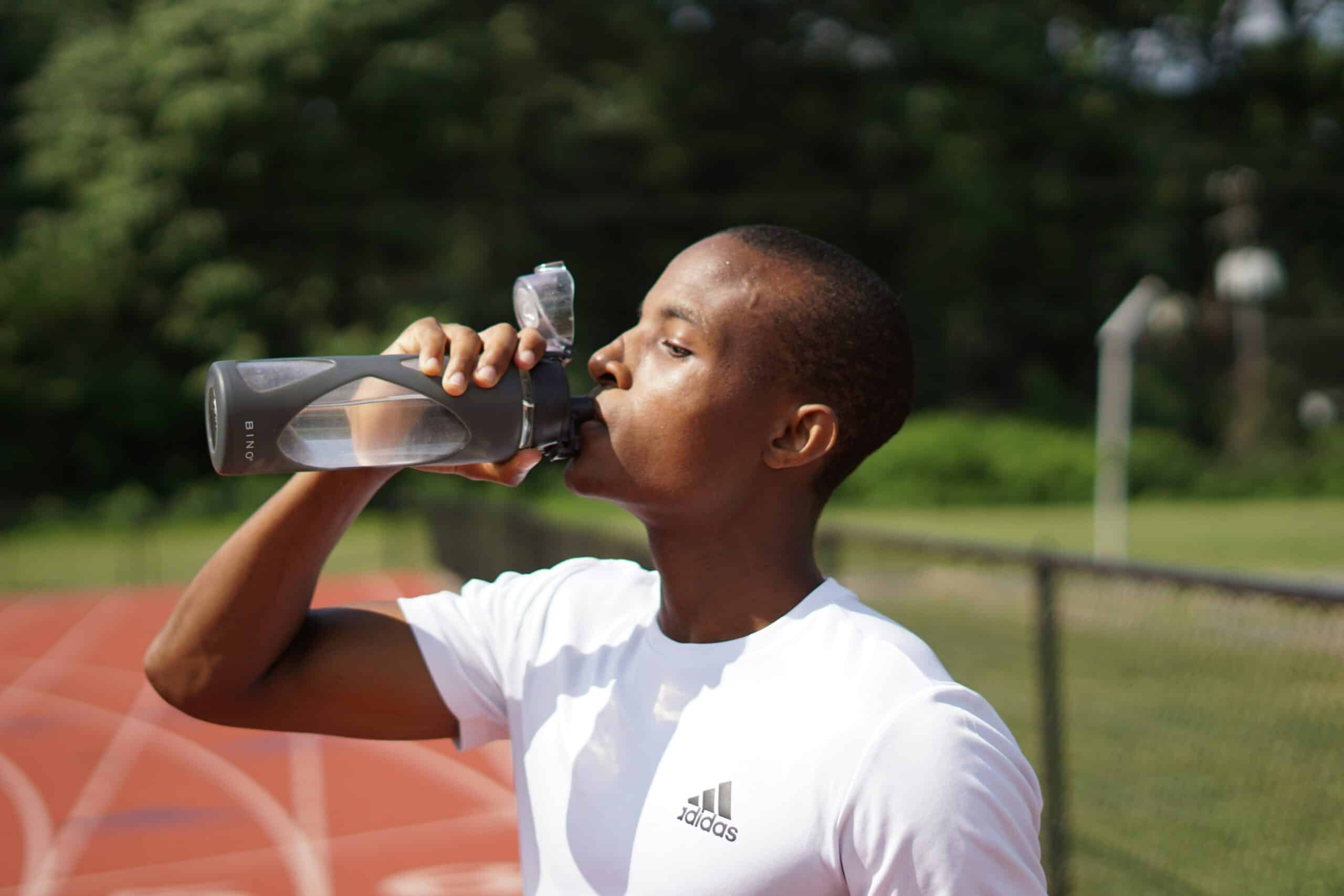
A migraine hydration target calculator turns a vague instruction to drink more water into a figure for the day and a pace for the hours inside it. Body weight sets the baseline, then activity, climate and caffeine adjust it upward.
Dehydration appears on most lists of commonly reported migraine triggers, alongside stress, sleep disruption and missed meals. Whether it matters for any one person is a separate question, and whether dehydration can trigger an attack covers how thin the individual evidence usually is.
Medical Disclaimer
This article is for educational purposes only and does not replace medical evaluation or treatment by a qualified clinician. Fluid needs change with kidney function, heart conditions, pregnancy and several medications. Anyone with a condition that affects fluid balance should take a target from their own clinician rather than from a calculator.
Quick Answer
Start at roughly half an ounce of fluid per pound of body weight across the day. Add for exercise, heat and altitude. Spread the total across waking hours instead of catching up in the evening, because an even pace is what a diary can actually match against attack days.
Key Takeaways
- All fluid counts, not only plain water.
- Pace matters as much as total, so the calculator gives an hourly figure.
- Exercise, heat and altitude each raise the target independently.
- Caffeine counts toward intake, though a steady habit matters more than the amount.
- Thirst arrives late, which is why a target beats waiting for the signal.
- A target is a starting point, and several conditions change it entirely.
Enter weight, then set activity, climate and typical caffeine.
| Body weight | Baseline | Light exercise day | Hot climate, active |
|---|---|---|---|
| 120 lb | 60 oz | 72 oz | 90 oz |
| 150 lb | 75 oz | 87 oz | 105 oz |
| 180 lb | 90 oz | 102 oz | 120 oz |
| 210 lb | 105 oz | 117 oz | 135 oz |
| 240 lb | 120 oz | 132 oz | 150 oz |
These figures describe total fluid from every source. Food contributes a meaningful share for most people, so hitting the number through drinks alone is not the goal.
Why a migraine hydration target calculator works from weight
Fluid turnover scales with body size. A fixed instruction such as eight glasses asks the same of a 120 pound person and a 240 pound person, which cannot be right for both.
Weight gives a defensible starting figure without pretending to precision it does not have. The number is a target to aim at, not a dose.
From there the adjustments do real work. Exercise and heat both raise losses through sweat, and altitude raises them through faster breathing and increased urine output.
Pace beats total over a long day
Two people can both reach 90 ounces and have completely different days. One drank steadily from waking. The other noticed at 8pm and drank 40 ounces in an hour.
Catching up late tends to produce a broken night rather than a hydrated one. The calculator divides the target across waking hours so the figure arrives as a rhythm.
An even pace also makes a diary readable. A day logged as “drank enough” tells you nothing, while a day logged as four hours behind the pace is a pattern you can test. People who lose track entirely may find the approach in staying hydrated when you forget to drink more practical than a target alone.
What the number includes and what it leaves out
Every drink counts
Tea, coffee, milk, juice and soup all contribute fluid. Treating only plain water as valid makes the target harder to reach than it needs to be.
Food contributes too
Fruit, vegetables and anything cooked in liquid carry water. That is one reason a skipped meal cuts fluid as well as calories, which skipping meals as a trigger gets into.
Caffeine is not a subtraction
Caffeinated drinks still add net fluid for habitual consumers. The calculator counts them in, then flags consistency rather than quantity.
Electrolytes sit outside the figure
Heavy sweating loses sodium as well as water, and water alone does not replace it. That gap is what electrolyte drinks address on long or hot days.
Testing whether hydration matters for you
Trigger identification has a high false-positive rate, and hydration is no exception. A day that ended in an attack often had several unusual features, and water was only one of them.
The useful test holds the target steady for several weeks while logging attack days. One week proves nothing either way, because attack frequency varies on its own.
Change one thing at a time. Raising fluid, cutting caffeine and fixing sleep in the same week leaves you unable to say which mattered, and a trigger tracker is where that discipline gets easier.
Carrying the day’s target in one container removes most of the counting. Several options in water bottles sized for a daily target are chosen around exactly that.
What trips people up
Waiting for thirst
Thirst is a late signal rather than an early one. A target exists precisely so the decision does not depend on noticing.
Treating the number as a minimum to beat
More is not automatically better, and very high intake dilutes sodium. The target is a target, not a floor to clear by as much as possible.
Forgetting that indoor heat counts
A dry heated room in winter raises losses the same way summer does. Set the climate input to what the room is, not to what the season is.
Front-loading the morning
Drinking most of the target before noon leaves the afternoon short. The hourly pace matters more than the hour you start.
Reading one good week as proof
Attack frequency moves on its own, so a quiet week after a change is weak evidence. Several weeks of logging is what separates a pattern from noise.
When to see a neurologist
Hydration is self-care at the edges of migraine management, not treatment. Book an appointment regardless of fluid intake if any of the following apply.
- A sudden severe headache that peaks within seconds or minutes.
- Headache with fever, a stiff neck, confusion or a rash.
- Headache after a head injury.
- New neurological symptoms such as weakness, numbness, slurred speech or vision loss.
- A first severe headache after age 50.
- A clear change in the usual pattern, location or intensity.
- Headache that wakes you from sleep or is worse on lying flat.
- Headache made worse by coughing, straining or exertion.
- Attacks on more days than not in a month.
- Acute medication needed on ten or more days a month.
- Aura lasting longer than an hour, or aura that is new.
- Attacks during pregnancy, or alongside new hormonal contraception.
- Vomiting that stops you keeping fluids or medication down.
Bringing a few weeks of logged data shortens that first appointment considerably, and questions worth asking a neurologist covers what to raise once you are there.
What a migraine hydration target calculator cannot tell anyone
It cannot say whether dehydration drives your attacks. It produces a reasonable daily figure, and the diary does the rest.
It also cannot account for medication. Diuretics, some blood pressure drugs and several migraine preventives all change fluid handling, and a clinician who knows the full list is the right person to set a figure.
Sources
- American Migraine Foundation
- American Headache Society
- Mayo Clinic
- National Institute of Neurological Disorders and Stroke
Frequently Asked Questions
How does a migraine hydration target calculator decide on a figure?
It starts from body weight, which is what fluid turnover scales with, then adds for exercise, hot or dry conditions and altitude. The result is a daily total and an hourly pace to spread it across.
Can dehydration trigger a migraine attack?
Dehydration appears consistently among commonly reported triggers, though trigger identification as a whole carries a high false-positive rate. Several weeks of logging, reviewed with a clinician, is how anyone finds out whether it applies to them.
Does coffee count toward the daily total?
Yes, for regular consumers it adds net fluid. The more useful question with caffeine is consistency of timing and amount rather than whether it counts.
Is there such a thing as too much water?
Yes. Very high intake over a short period can dilute blood sodium, which is why the calculator produces a target rather than a figure to beat. The risk is highest with large volumes drunk quickly during endurance activity.
Should the target change on an attack day?
Vomiting raises losses, so intake matters more on those days and often has to come in small sips. Fluids that will not stay down are a reason to contact a clinician rather than to keep trying.
How long before a hydration change shows up?
Give it several weeks at a steady target while logging attack days. Attack frequency fluctuates by itself, so shorter tests tend to produce conclusions that do not hold.
When should I see a doctor about migraine attacks?
Book an appointment for any sudden severe headache, any headache with fever or neurological symptoms, a first severe headache after 50, a clear change in your usual pattern, attacks on more days than not, or acute medication needed on ten or more days a month. Hydration is self-care at the edges and does not change any of those.
