
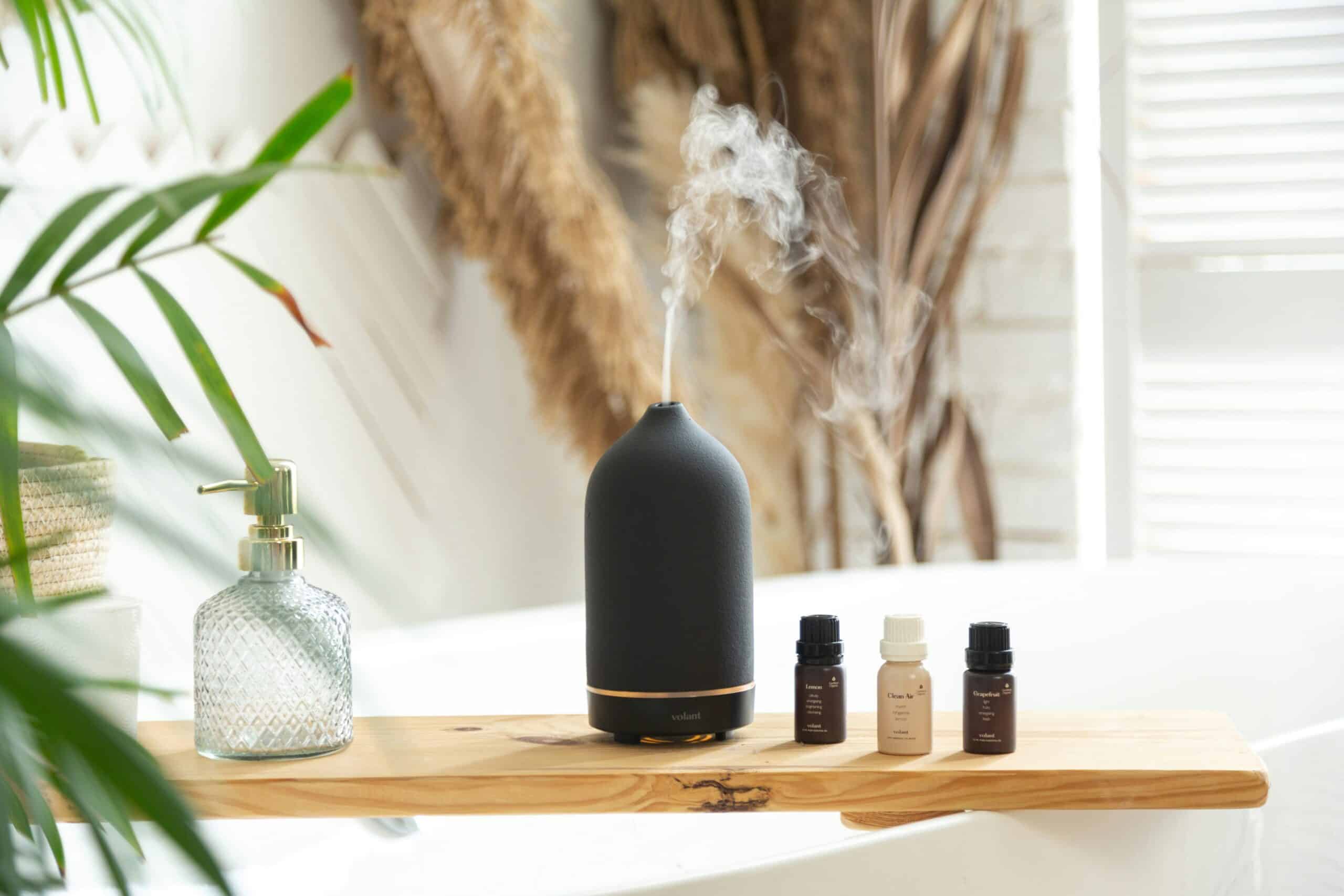
Aromatherapy alone will not stop a migraine, but a steady stream of peppermint or lavender vapor can quiet the room, soften nausea, and make a dark recovery space feel less hostile. The right diffuser disperses a fine, consistent mist without heat, without noise, and without a harsh fragrance hit that worsens the attack.
This guide compares five diffusers that work well for migraine sufferers. Ultrasonic models keep oils cool, run quietly, and double as humidifiers, which matters when winter air and migraines combine. Picks span budget plastic units, ceramic premium options, and large-tank models for whole-room coverage during long attacks.
As someone who gets migraines, I want a diffuser that runs silently, shuts off automatically, and does not require fiddling. The picks below were chosen with that bar in mind.
Quick Verdict:
- Best for: migraine sufferers who want a quiet, hands-off way to use essential oils during attacks and in regular wind-down.
- Skip if: you are sensitive to all scents, including light ones; diffused oils may worsen the attack rather than help.
How We Chose These Migraine Diffusers
Selection focused on near-silent operation (under 30 dB), automatic shutoff when water runs dry, no heat (heat damages oils and creates burn risk), and tank size proportional to runtime. Models with harsh LED lighting or constant noise were excluded; both are migraine triggers.
For oil pairing context, see the best essential oils for migraines and the best peppermint oil rollers. Aromatherapy works alongside other interventions; it is not a replacement for medical treatment.
Decision Matrix: Which Diffuser for Which Use Case
| Use Case | Tank Size | Top Pick |
|---|---|---|
| Bedside use during attack | 200-300 ml | VicTsing 300ml |
| Whole-room overnight coverage | 500 ml or larger | ASAKUKI 500ml |
| Quiet office or workspace | 150-300 ml | InnoGear 150ml |
| Premium ceramic for living areas | varies | Vitruvi Stone |
| Budget pick | 500 ml | URPOWER 500ml |
1. ASAKUKI 500ml Premium Essential Oil Diffuser: Best Overall Pick
The ASAKUKI 500ml hits the right balance of size, run time, and silence for migraine use. A full tank runs up to 16 hours on intermittent mode, the auto-shutoff prevents dry-running damage, and the LED light can be turned off entirely, which is non-negotiable for migraine recovery. The mist output is consistent rather than pulsing, which matters for a steady scent rather than waves of intensity that can themselves provoke nausea during an attack.
The ceramic-style outer is plastic but textured to look more upscale than the typical clear-plastic diffuser. Filling is straightforward through a removable top cover. Cleaning is the only friction point: mineral buildup from tap water requires periodic citric acid soaking to keep ultrasonic plates working efficiently.
Best for
Whole-room coverage during long attacks or overnight use. Functions as a humidifier too, helpful when dry winter air contributes to attacks.
Skip if
You have a small space and want something more discreet; this is a larger unit and looks like a small humidifier.
Check Price on Amazon2. VicTsing 300ml Cool Mist Diffuser: Best for Bedside Use
The VicTsing 300ml is sized right for nightstands and small rooms. It is genuinely quiet (under 25 dB), the mist output is consistent, and the lighting can be fully dimmed or turned off. Run time is roughly 6 to 10 hours depending on mist setting, which covers a full sleep cycle on a single fill for most users.
Build is teardrop-shaped plastic, smaller and more discreet than 500ml options. The control panel is two buttons (mist intensity and light), simple enough to operate in low light or with eyes mostly closed during a migraine attack.
Best for
Bedside placement during attacks; small bedrooms or recovery rooms; users who want a compact form factor.
Skip if
You need to cover a large open-plan space; 300 ml is undersized for whole-room coverage past a few hours.
Check Price on Amazon3. InnoGear 150ml Aromatherapy Diffuser: Best Compact Option
The InnoGear 150ml is the smallest in this list and the quietest. It runs roughly 3 to 6 hours per fill, which suits attack windows where you do not want to refill or worry about the device. The compact size makes it portable across rooms, which matters when you start an attack at your desk and need to move to a dark bedroom.
The single power button cycles through mist settings and light options simply. Build quality is basic but functional, and at this price point the unit is sometimes treated as a backup or office secondary rather than a primary device.
Best for
Travel, office use, or migraine sufferers who want a device they can move between rooms easily.
Skip if
You want overnight runtime without refilling; this needs refilling every few hours.
Check Price on Amazon📑 Recommended Read: The diffuser is one half of the equation; the oil itself matters more. Lavender, peppermint, and eucalyptus are the most-studied oils for migraine support, and oil quality varies widely. See the best essential oils for migraines.
4. URPOWER 500ml Essential Oil Diffuser: Best Budget Pick
URPOWER’s 500ml model offers similar capacity to the ASAKUKI at a lower price point. It runs nearly silently and has color-changing LED that can be disabled. Build quality is more basic than premium picks but the core function works reliably for the price tier. Mist output is comparable to the ASAKUKI in real-world testing despite the lower cost.
The plastic build is the trade-off; it does not look or feel as premium as ceramic options. For migraine use, function matters more than appearance, and URPOWER delivers the function. Replacement parts are easy to find if a component fails.
Best for
Budget-conscious buyers who want larger tank capacity without paying for premium build or ceramic finishes.
Skip if
You want long-term durability or premium materials; this is plastic and the build reflects the price point.
Check Price on Amazon5. Vitruvi Stone Diffuser: Best Premium Ceramic Option
The Vitruvi Stone is the premium pick: hand-finished ceramic, ultrasonic operation, and a clean aesthetic that fits living-area placement. Tank capacity is smaller (around 90 ml) so it runs around 4 hours per fill, but the quality of build and lack of plastic appeal to many migraine sufferers who keep diffusers running often. The materials matter for users sensitive to off-gassing from cheap plastics.
Only two buttons: mist on/off and timer cycling. No light, no color-changing, no LCD. The minimalism is deliberate and suits migraine recovery spaces where any visual stimulation can worsen the attack. Cost is several times that of budget picks, which is the main barrier.
Best for
Living rooms, offices, or anyone prioritizing aesthetics and material quality; gift-giving option.
Skip if
You need long runtime or large capacity; this is smaller than the budget picks despite the higher price.
Check Price on AmazonHow to Use Essential Oils Safely During a Migraine
Add a few drops of essential oil to the water-filled tank; do not add oils directly to the heating element of any diffuser model. Start with two or three drops and increase only if needed; strong scent concentrations can themselves trigger migraines in some sufferers. Peppermint and lavender are the most-studied oils for migraine support, per the American Migraine Foundation.
If a particular scent worsens the attack, stop immediately and ventilate the room. Track which oils help and which trigger you using a migraine diary app.
Aromatherapy diffusers work best when paired with other migraine-relief tools rather than used as a standalone intervention. During an active attack, a diffuser running peppermint or lavender in a dark room with an eye mask and minimal noise produces better recovery conditions than any single tool alone.
For chronic migraine sufferers, a diffuser running during evening wind-down (with calming oils like lavender or chamomile) supports the broader sleep-hygiene approach that reduces frequency. Pair with a pillow that supports your sleep position and consistent sleep timing to address one of the top trigger categories.
For workplace use, smaller portable diffusers (like the InnoGear) help during the early warning phase of an attack, when reducing sensory load can sometimes interrupt the cycle before full pain sets in.
Common Diffuser Mistakes
Using too much oil at once: strong scent can trigger rather than soothe. Less is more during an active attack. Running the diffuser without water: damages the unit and creates burn risk. Always check the water level before starting a session. Buying scented or “fragrance” oils instead of pure essential oils: synthetic fragrances often trigger migraines. Stick to pure essential oils from reputable sources.
Frequently Asked Questions
Will a diffuser stop my migraine? No diffuser stops a migraine on its own. They can support comfort during recovery and reduce some symptoms (nausea, tension) for some users. They are an adjunct, not a treatment. If your migraine pattern responds noticeably to aromatherapy, it is a useful addition to your toolkit, but should not replace medication or professional care for severe or chronic patterns.
Which oils work best for migraines? Peppermint and lavender have the most research backing for migraine comfort. Eucalyptus helps with sinus-related pressure. See the essential oils guide for details.
How long should I run the diffuser? A session of about a half-hour to one hour is typical. Running constantly can lead to scent saturation and may itself trigger headaches in sensitive users. Many migraine sufferers find an intermittent setting (where the diffuser pulses on and off automatically) more comfortable than continuous operation, especially during long recovery sessions.
Is ultrasonic safer than nebulizing? Ultrasonic diffusers use water and a small vibrating plate, with no heat. Nebulizing diffusers use pressurized air to disperse oil directly with no water. Ultrasonic is generally considered gentler for migraine use.
When should I see a doctor? For new migraine patterns, worsening frequency, or migraines accompanied by neurological symptoms (vision changes, weakness, confusion), see a doctor or migraine specialist promptly. See how to find a migraine specialist.
This article is for general information and is not medical advice. For persistent or severe migraines, consult a doctor or migraine specialist.
For the wider picture, see our guide to how to choose migraine tension relief.
Sources
- Headache Classification Committee of the International Headache Society. The International Classification of Headache Disorders, 3rd edition. Cephalalgia. 2018;38(1):1-211. https://ichd-3.org/
- National Institute of Neurological Disorders and Stroke. Migraine. National Institutes of Health. https://www.ninds.nih.gov/health-information/disorders/migraine
- Lipton RB, Bigal ME, Diamond M, et al. Migraine prevalence, disease burden, and the need for preventive therapy. Neurology. 2007;68(5):343-349. https://www.neurology.org/
